Contains spoilers
First some housekeeping. Following the publication of this post, I will be switching over to Substack. Still the same name and format, I’ll be just be housed elsewhere. Once I’ve shifted everything over, I will send an email out with the details. No obligation to resubscribe, I would love it if you joined me though.
I’ve been thinking about Nicolas Cage more than usual. I used Cage characters to add a bit of life to a presentation I gave at work (which actually went down very well) and I am stupidly excited about the Spider-Noir series which airs on Amazon Prime this month. The teaser trailer looks better than promising and as someone who loved (so, so much) Spider-Man: Into the Spider-Verse (2018), this looks to be a genuinely interesting spin-off. I’m not sure how I feel about the whole “authentic black and white” and “true-hue full colour” versions. I lean more towards a noirish black and white for the hard-boiled gumshoe experience but then I’ve seen some incredible noir films in colour, Devil in a Blue Dress (1995) being a notable example. I’ll see how they go before commenting. I will of course be watching both.
I’ll be covering two films from Cage’s filmography which were released in 1987. They are very different films but what links them is the line they draw under Cage’s career in teen films or as part of the coming of age genre. More on this to come so let’s get into it.
Raising Arizona (1987, dir. Joel Cohen, written by Joel and Ethan Cohen)
Plays H.I. “Hi” McDunnough, a career criminal who cannot walk past a certain convenience store chain without donning a stocking and robbing it. Due to Hi never using a loaded gun, he is paroled quickly only to be arrested shortly afterwards. His recidivism sees him frequently cross the path of Holly Hunter’s police officer Edwina, known as Ed. Hi falls for Ed and after being paroled, proposes marriage, renouncing his criminal lifestyle. Hi gets a job and they realise after much trying that they can’t have children. Due to Hi’s past they cannot adopt so they kidnap one of the quintuplets recently born to a local businessman’s wife called Nathan Jr. Several other characters enter the fray threatening the McDunnough’s shaky domestic bliss.
Teeth Watch: The original teeth are back and the gaps from the previously yanked out baby teeth appear to have been filled or at least hidden. This means they look healthier than in Birdy but still delightfully flawed.
Best Cage Rage Moment: Despite dealing with some pretty strange moments, Cage’s character is often the least deranged. I could name the epic fight in Hi and Ed’s trailer when escaped convicts Gale and Evelle Snoats (John Goodman and William Forsythe) overpower Hi and tie him to a chair. However, his howl of anguish when Nathan Jr. is taken by the brothers is more sad than angry. Plus the fight is just too comedic. Gale helicopters Hi around the room utterly trashing it. Then there’s the bit where Hi appears to have the upper hand until he raises both arms to finish the job only to painfully scrape them on the trailer’s popcorn ceiling.
The rage moment I will mention is utterly justified. When Hi and Ed have his awful foreman, Glen (Sam McMurray), and his family over for dinner, Hi smashes his nose when Glen suggests they wife swap. The scene ends with Hi shouting “keep your god-dammed hands off my wife” as Glen runs face first into a tree.
Best Cage Quote: Honestly, the best quotes come from Nathan Arizona (Trey Wilson), particularly when dealing with the police following his son’s kidnap. When asked if the baby was naked when taken, Arizona screams “no one sleeps naked in this house!”. He is interviewed by the press on his doorstep and a reporter enquires if it’s true that aliens took their son, he responds “don’t print that son, his momma reads that she’s just gon’ lose all hope”. He then makes sure the press pack know that it’s still business as usual at Unpainted Arizona.
Cage does have some great lines, particularly during the scene when he and Ed take Nathan Jr. Hi is grappling with the five babies in the nursery whilst their parents are downstairs. He returns to Ed empty-handed, describing the scene as “kinda horrifying”. After being given short shrift, Hi grabs Nathan Jr. and after handing the baby to Ed he throws in a Dr. Spock book noting “here’s the instructions”.
Of interest, Hi’s bafflement when dealing with the babies would not have been a stretch for Cage. In a 1987 interview with Bobby Wygent, he talked about how he’d never handled a baby before (the film used fifteen babies in total). Cage found the babies weird as they don’t seem human but almost alien. Which naturally he appreciates.
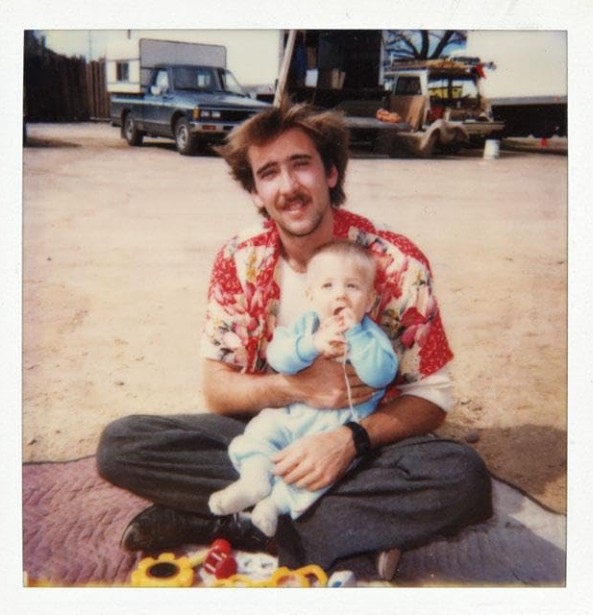
Best Cage Wardrobe: Does hair count? He has a magnificent head of hair throughout the film. Even when Hi attempts to tame it for formal situations, it always looks on the verge of springing right back up again.
Notable Moments:
For me, this is the role when Nic Cage really becomes an actor in his own right. It made me consider how differently his career trajectory could have gone had he continued to take the teen type roles for a bit longer (although admittedly, with him looking a fair bit older, I’m not sure how long he could have taken them). His look is not hugely different – his wild hair was seen in Valley Girl and Peggy Sue Got Married as were his prominent eyebrows. The difference is he seems to wear it more comfortably and the hapless yet well-meaning Hi gives Cage a chance to show his comic chops and timing.
I think Joel Cohen gets an exceptional performance from Cage. Of interest, it was through curtailing the actor’s improvisations which previous directors were happy to indulge. The relationship between them could be tense due to the Cohens refusing to compromise on their script and their more autocratic method of storytelling. I’ve thought a lot about this conflict and Hi’s character. Ultimately he is a decent person and his growth, which culminates in his final dream sequence at the end, is well-earned. Had Cage had free reign, it may have pulled focus from the more subtle elements in the character’s story arc.
Back to the notable moments, there are so many. The film is cartoonish (Simon Pegg once described it as a “living, breathing Looney Tunes cartoon”, this was also the Cohen’s vision), not just in the more lunatic sequences but in the scenery. With the large rock formations in the background and surrounding cacti, Hi and Ed’s trailer could be right in the middle of a Wile E. Coyote story. The grizzled and terrifying bounty hunter, Leonard Smalls (Randall Craig Cobb), who Hi believes was unleashed following the discovery of Nathan Jr.’s disappearance (and his own prophetic nightmare), is always great on screen. His merciless, random killing of cute bunnies invoking the spectre of Yosemite Sam.
My favourite moment has to be the chase sequence following Hi’s attempt to rob a garage whilst Ed and Nathan Jr. wait unknowingly in the car. Ed drives off and leave Hi clutching the stolen Huggies. This chase has everything – gun-toting cashiers and cops, a carjacking with a screaming truck driver, Hi thrown through a window and chased through houses and a supermarket by said gun-toting folks and a pack of dogs. It is bonkers and yet so meticulously shot, I want to applaud when it concludes. Amazing on every level, not least when Hi is rescued by Ed and he is calmly giving her directions despite the recent insanity and her evident (and justified) hysteria.
Moonstruck (1987, Dir. Norman Jewison, written by John Patrick Shanley)
Loretta Castorini (Cher) is a recently widowed bookkeeper who believes that she’s unlucky in love. She accepts a proposal from gentle mummy’s boy Johnny Cammareri (Danny Aiello). She admits to her mum, Rose (Olympia Dukakis) that she doesn’t love her fiancé but she likes him. When Johnny heads to Sicily to be with his dying mother, he asks Loretta to contact his estranged brother, Ronny (Nicolas Cage), and invite him to the wedding.
When Loretta meets Ronny, he is a sweaty, filthy mess working the ovens in his bakery basement. He is still enraged at his brother who he blames for losing his hand and his bride. Loretta is unimpressed by his temper but there is instant chemistry and he whisks her off to bed. When she tries to end it, Ronny asks her to join him at the opera just once and then he’ll leave her alone. She agrees and they spend a night at the opera, where Loretta encounters her unfaithful father with his mistress.
Johnny’s mother makes a miraculous recovery, bringing him back to Brooklyn earlier than planned so Loretta, who has fallen for Ronny, has a big decision to make.
Teeth watch: The gaps from when Cage yanked his milk teeth for Birdy are very visible. I believe Raising Arizona was filmed before so he possibly had temporary fillers (I really do spend this long pondering his teeth). The gaps look great, it adds to his character and I felt that Jewison made a lot of Cage not being conventionally handsome when we first encounter him. He’s just raw, untamed sex appeal.
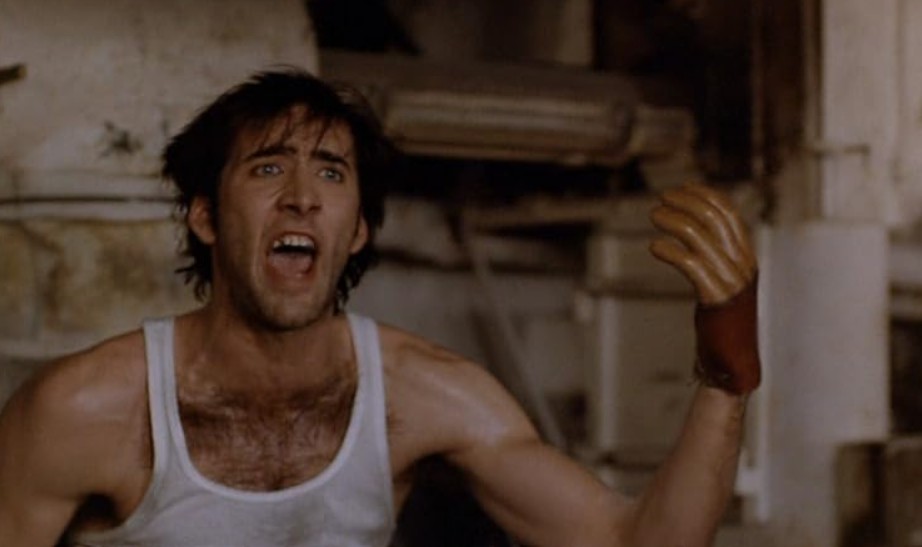
Best Cage Rage moment and quote: We’re still in that basement and I’ve smooshed these two categories as it’s all in the same scene. When Loretta suggests that Johnny is not responsible for Ronny losing his hand, he flips spectacularly. He smashes stuff and roars, “I don’t care, I ain’t no freakin’ monument to justice! I lost my hand! I lost my bride!”, pointing at his wooden hand dramatically. As an aside, this scene is Cage making a direct homage to the scientist C.A. Rotwang (Rudolph Klein-Rogge) from Fritz Lang’s Metropolis (1927).
There are other great quotes, Ronny flipping a table and shouting “son of a bitch!” before scooping up Loretta and taking her to bed. Then there’s the scene after they see La Boheme and Loretta is trying to break things off, Ronny’s (charming) response is “The storybooks are bullshit. I want you to come upstairs with me and get in my bed!”. Unsurprisingly it works.
Random Cage fact revealed during research: I’ve added this new category as Cage seems to reveal something interesting (and usually batshit) about himself during or around the same time a film is released. For Raising Arizona, he talked about being covered in paint when meeting the Cohens due to his hobby of painting rockets and letting them off in the park. For Moonstruck, it was reported that Cage owned two sharks (not clear where he kept them), exotic insects and a jewel encrusted tortoise. He described his love of marine biology to Playgirl, telling the interviewer “I have a picture of a fish in my wallet that is just going to knock your socks off”. It’s hard not to think of Troy McLure.
Best Cage wardrobe: It has to be the suit Ronny wears when taking Loretta to see La Boheme. He looks incredibly handsome and it’s a contrast to the vest-clad, howling lunatic she had encountered previously. It’s worth noting that at this point several of the characters have been affected by the full moon and there are many nods to its influence. Whilst Ronny is consumed by his passion for Loretta, he seems calmer. His hair is tamed, his eyes focused and he exudes confidence. You could conclude that Ronny is a reverse werewolf or being ‘moonstruck’ allows him clarity rather than confusion. Or he’s content with the operatic drama playing out on stage. Whichever way you look at it, I like it.
Notable moments
I’m not a natural lover of rom-coms but I enjoyed this film. The script is sharp, the performances are great and the operatic storyline is delivered perfectly. Having said that, it’s not my favourite Nic Cage performance. He is fantastic and I agree with Cher, when she was discussing his casting, that no other actor could deliver the “bring me the big knife” line. The problem is he has very little to do beyond that first meeting with Loretta. A positive reason for this is that Moonstruck contains multiple characters and interactions. Hat tip to Perry (John Mahony) and Rose’s dinner at an Italian restaurant. This scene doesn’t move things on plot-wise but I wouldn’t change a second of it. I absolutely have to mention the moment when Loretta is watching Johnny’s plane taking off. A cackling old lady tells her she’s put a curse on it as her sister, who stole her man 50 years ago, is on board.
There just isn’t space within its 102 minutes to fully flesh out Ronny’s character. That said, Cage does make an impression and he has very convincing chemistry with Cher, but this is her film and rightly so.
As operatic tropes thread through this film, we naturally have a grand finale. The gathering of our main characters takes place in the Castorini’s kitchen. I love the dynamics of this scene. Rose tells Cosmo (Vincent Gardinia) he has to stop seeing his mistress, Johnny declares he can’t marry Loretta as his mother may get sick again and her pop (Feodor Chaliapin) starts crying when Ronny proposes to Loretta saying he’s confused. It ends with a celebration and a toast to family. It’s such a joyous ending (I want to be chugging fizz with that Italian-American family so hard) that it was strange to read how difficult that particular scene was to shoot.
Reports suggest that tensions escalated to the point where the group stopped taking direction, cocked up multiple takes and shouted at one another. Jewison told a reporter in 2011 that Cage got so riled, he threw a chair at another actor. Jewison demurred from saying which actor but my money is on Aiello. He apparently grabbed his nuts and bellowed at Cage “you gotta give it to me from here!”. I can only surmise he had never met Cage or had engaged with his work prior to making that statement.
Next time: Robocop (1987, dir. Paul Verhoeven) – as noted above, this will drop on my new Substack page. Details and how to subscribe will be communicated anon.
View from the Ferris Wheel
As you’d expect, I’ve smashed an insane number of films since the last post so will just give you the highlights:
I made my first visit to The Nickel, a newish grindhouse cinema in Clerkenwell, London. I watched a John Schlesinger double bill – Pacific Heights (1990) and The Believers (1987). The latter was flawed but interesting. I have so much to say about Pacific Heights so will hold off, I plan on making it a future post.
I have been watching quite a few Play for Today episodes courtesy of the collections I have on Blu-ray. Standouts have been The Photograph (1977, dir. John Glenister) and The Lie (1970, dir. Ingmar Bergman). Fuck, they were good. I’m nervous about watching the Channel 5 re-boot but I’ll get to them. I’m hopeful they’re as challenging and intelligent as the original series.
Hard Boiled (1992, dir. John Woo) – saw this banger at the cinema. First time watch, eternally in love. Ridiculous and sublime.
Project Hail Mary (2026, dir. Phil Lord & Christopher Miller) – I loved that Rocky was a puppet, I loved that they were not heavily reliant on CGI and I love that this is the kind of Spielberg style family film that just doesn’t get made anymore. My friend and I saw at the BFI IMAX and were utterly won over.
The Secret Agent (2026, dir. Kleber Mendonca Filho) – joyously soaked up every damn second of this film. As a side note, the needle drops are *chef’s kiss*
Sirāt (2026, dir. Oliver Laxe) – went in blind. Loved the vibe of rave culture, made me wistful for the 1990s but bloody hell, it takes a turn. It’s no longer in cinemas but watch this with the best speakers possible. It’s an incredible piece of work.
Best in Show (2000, dir. Christopher Guest) – saw this at the cinema, first time viewing. Loved that the audience had a healthy number of 20-somethings. Pissed myself laughing and couldn’t believe it had taken me so long to see it.
My Father’s Shadow (2025, dir. Akinola Davies Jnr.) – incredible on many levels, compassionate look at a paternal relationship during the backdrop of political unrest in Nigeria. I was thinking about this for a long time afterwards.
The Mastermind (2025, dir. Kelly Reichardt) – she does it again. Understated but never holds back from a quiet skewering of characters. This is my third Reichardt film and I seriously need to complete her back catalogue.
The Drama (2026, dir. Kristoffer Borgli) – this gets a notable mention as it was way better than I expected. Great performances (as you’d expect from this cast) but it was that rare film where I left quite ambivalent. Then I thought about it, talked it through with someone and I realised it was bloody brilliant. Go in knowing as little as possible.
The Lair of the White Worm (1988, dir. Ken Russell) – thanks to my sister showing me this when I was way too young, I’ve been terrified of it for years. My adult self was well into it. An interesting look at Christianity and Paganism with some surreal imagery and scene-chewing performances.
 The Cuckoo Clock Film Blog