It has been a while: I won’t bore you with the full details. The succinct version is I wrapped up a very busy role at the end of January and moved into a new post as an Archive Researcher in early February. This has been great but it’s also been a steep learning curve and, for a while, I just lost the motivation to write. More specifically, I lost the mojo to write this blog. Losing momentum is a terrible thing and with each month, the task of simply getting a post knocked together seemed increasingly impossible.
I subscribe to a lot of brilliant writers and thinkers on Substack and I recommend Elsewhere Underwritten, it’s the musings of a gent who took a career break to write a novel. He’s intelligent and likeable company and is honest about his battles with motivation and allowing life circumstances to swallow up his writing time. It was his post, Your Life is not a Masterpiece, which relit my lightbulb and I finally picked the thread back up again.
The break did allow time for some introspection around how the blog was evolving and what changes I might like to make. The posts are definitely too long. I don’t have the time to sustain them and I doubt most of you have the time to read them. That’s OK though, this was always a personal project to encourage me to write regularly and adjustments are a healthy part of that process. They will come in shorter and, I hope, with a bit more regularity. Let’s get right back into it with my dude.
When I decided to watch all of Nicolas Cage’s films as a side project to the blog, it was important to see them in chronological order. Despite heavily engaging with Cage’s filmography, I felt his evolution as an actor was something I had missed so I have been very strict on this. Streaming platforms with their distribution and copyright challenges can royally piss on such ambitions hence why I am having to skip Cage’s performance in Charles Jarrett’s The Boy in Blue (1986). This is only available to “buy”* on Amazon Prime so unless I spot the DVD in a charity shop, I’ll have to wait until I can rent it.
I did see what I could dig up about the film in the meantime. There were no interviews or articles online although YouTube has this pretty ropey trailer and, via the BFI Reuben Library, I was able to read some reviews. One notable quote is from the New York Times published in May 1986 where the film was called a “witless, tedious contrivance”. Keith Phipp’s book Age of Cage briefly mentions the film, calling it “dully directed” and stating it’s the first film that even Cage “didn’t know how to light up”. Despite the trailer showing him looking pretty shredded in a vest, I was not inspired to part with £8.99 to watch it. As and when I can get my hands on the film, I will include it in a future Cageathon post.
*I use the quote unquote symbol here as you never really own a film when purchased via a streaming platform. Always buy the physical media, lads.
The film after The Boy in Blue is thankfully more available. Let’s get into it.
Peggy Sue got Married (1986) directed by Frances Ford Coppola
Peggy Sue (Kathleen Turner) is attending her school reunion without her husband and high school sweetheart “Crazy” Charlie Bodell (Nicolas Cage). They are divorcing as he’s having an affair with a younger woman. At the reunion Peggy Sue connects with old friends and when she’s crowned Queen alongside former school nerd, Richard (who is now a smart, successful tech entrepreneur) as King, she faints onstage. Peggy Sue wakes up in 1960 and she’s back in school as a teenager, dating Charlie but knowing everything she knows as an adult. This makes her rethink her romantic and life choices.
Teeth watch: Where to start with this. Cage insisted on wearing fake teeth when playing Charlie which actually foreshadow the tombstone like fascias that Cage permanently sports later on in his career. They really don’t look great and sit awkwardly in his mouth. It reminded me of the Joke Shop vampire teeth I wore to school once in the 1980s and promptly had confiscated by a teacher.
Best Cage Rage: When hearing that teen Peggy Sue has been seen around town with sexy weird kid, Michael (Kevin J. O’Connor), Charlie sneaks into her bedroom via the window and mimics smothering her with a pillow. He then wakes her and, not unlike a serial killer, makes her go down to the basement so they can talk. Charlie loses his shit and not unreasonably she breaks up with him. This Cage Rage moment should make you dislike Charlie however I just felt sad for him. Cage is able to bring nuance to what could have been a standard jock-dude rant. It demonstrates how toxic masculinity can be just as harmful to men. His inability to see Peggy Sue as a human being with agency is as damaging to the relationship as her carrying on with the book-smart dude.
Best Cage Wardrobe: given the period, there’s a decent amount to choose from, not least his pale yellow V-neck jumper. My personal favourite is the music note shirt and gold sequined jacket worn when Charlie performs with his barbershop quartet.
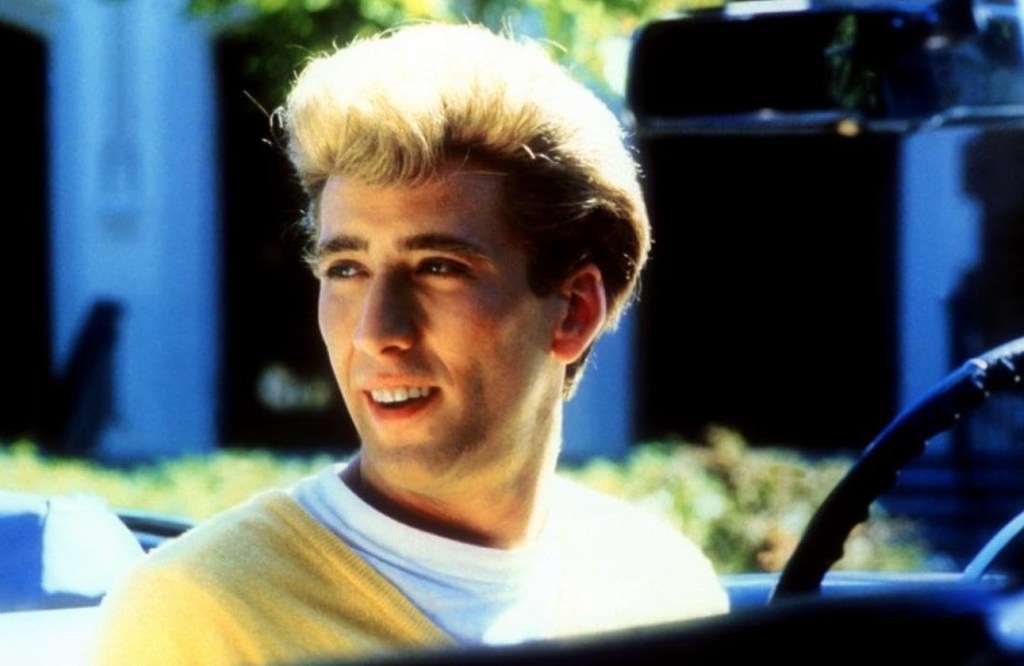
Best Cage quote: Charlie has a full-on freak out when woman-in-a-teen-body Peggy Sue wants to have sex with him. Despite appearing to be a horny sack of man fat in previous conversations, Charlie is thrown by the gender role reversal, claiming she is saying “guy lines”. As she tries to placate him he kicks her out of his car and drives off shouting “Save it, woman. HUMILIATOR!”.
Final thoughts: Peggy Sue isn’t what I’d call a great film but it moves along nicely and there are some pretty funny moments. I struggled with Cage’s weird voice (inspired by the character Pokey from the kid’s stop-motion show Gumby) and fake teeth but then it started to work. I agree with author Keith Phipps, in that these eccentricities work because Peggy Sue had idealised him. When she encounters High School Charlie again with her adult brain, the voice and teeth are a quick signifier that he’s not the hot romantic hero of her memory. It’s an interesting premise which allows the teenage relationship move into a more mature space. This is achieved by Peggy Sue refusing to fall in line with Charlie’s fixed idea of their gender roles but also by her really seeing him as a human being too. Her new perspective shows a young man who was determined to become a singer and had those hopes dashed in a pretty humiliating way, forcing him into a career he hated.
There is also Michael, the bookish school loner that Peggy Sue hints at being the one who got away. I love the storyline of her taking the chance to pursue and seduce him. Her fantasy of a life with him swiftly crumbles when he suggests they run away to Utah and stay with his friend Rita on her chicken farm. So far, so lovely, until Michael reveals Peggy Sue can take care of chickens whilst he writes. An honourable mention is due to the sweet friendship she strikes up with nerdy science kid Richard (Barry Miller) who she knows will become successful as an adult from his inventions. This desire to reconnect with someone she had otherwise ignored for shallow reasons feels very genuine.
Ultimately the mawkish and rushed conclusion doesn’t really work. Peggy Sue wakes up in the present and she immediately reconciles with Charlie. His voice now sounds like someone who cold calls women to sexually harass them and the teeth just seem odd on an adult gent. Having said that, it was Cage’s portrayal of Charlie that led to him being cast in Moonstruck (1987), which we will get to in a future post.
Next time: Claudia Weill’s Girlfriends (1978)
View from the Ferris Wheel:
I’ve seen a ridiculous number of films since January so I won’t subject you to the full list (I have a spreadsheet; I really need to convert it into a Letterboxd account):
Some of the highlights, new and classic, that I’ve recently caught up with:
Small Things Like These (2024), dir. Tim Mielants
Grand Theft Hamlet (2024), dir. Pinny Grylls and Sam Crane
Cure (1997), dir. Kiyoshi Kurosawa
Blade (1998), dir. Stephen Norrington
Sergeant Rutledge (1960), dir. John Ford
Hard Truths (2024), dir. Mike Leigh
Black Girl (1966), dir. Ousmane Sembene
Memoir of a Snail (2024), dir. Adam Elliot
I’m Still Here (2024), dir. Walter Salles
A Real Pain (2024), dir. Jesse Eisenberg
The Seed of the Sacred Fig (2024), dir. Mohammed Rasoulof
Ratcatcher (1999), dir. Lynne Ramsey
Four Daughters (2023), dir. Kaother Ben Hania
Blow Out (1981), dir. Brian De Palma
On Falling (2024), dir. Laura Carreira
Sister Midnight (2024), dir. Karan Kandhari
Mr McMahon (2024), dir. Chris Smith (this is a Netflix mini-series and I was unashamedly hooked so it gets an honourable mention)
Scanners (1981), dir. David Cronenberg
A Different Man (2024), dir. Aaron Schimberg
Polite Society (2023), dir. Nida Manzoor
Wanda (1970), dir. Barbara Loden
Santosh (2024), dir. Sandhya Suri
A Moment of Innocence (1996), dir. Mohsen Makhmalbaf
Last Summer (1969), dir. Frank Perry
Westward the Women (1951), dir. William A. Wellman
Dazed and Confused (1993), dir. Richard Linklater
Night Watch (1973), dir. Brian G. Hutton
Hud (1963), dir. Martin Ritt
Amadeus (1984), dir. Miloš Forman
Q: The Winged Serpent (1982), dir. Larry Cohen
Sinners (2025), dir. Ryan Coogler
I’ve been reading a bunch too so here are some fiction recommendations:
Aunt Julia and the Scriptwriter by Mario Vargas Llosa
Universality by Natasha Brown
The Lonely Londoners by Sam Selvon
Creation Lake by Rachel Kushner
Orbital by Samantha Harvey
Mr Loverman by Bernardine Evaristo
Butter by Asako Yuzuki
 The Cuckoo Clock Film Blog