
Contains spoilers
I couldn’t tell you the exact year I first watched Bob Clark’s A Christmas Story. It would have been the mid to late 1980s and we had a copy on VHS recorded from the television. I lost track of it as I entered my teens and adulthood but I thought about the film often and found that most people I mentioned it to had never heard of it. I couldn’t find a copy in shops or at Blockbuster Video (remember them?) so I gave up looking.
A few years back I brought the film up to a friend of mine, who spent some of his childhood in California, and he enthusiastically recalled it although had also never seen it for sale or rent in the UK. My friend eventually gifted me the DVD: I still have it and it’s watched several times every Christmas. Next to Die Hard (1988), it is my all-time favourite Christmas film.
To give a little background, A Christmas Story is set in the 1940s and based on the semi-autobiographical book In God We Trust: All Others Pay Cash by Jean Shepherd. The book is a collection of short stories which are inspired by Shepherd’s childhood in Indiana. As well as being an author, he was a well-known radio host and it’s his dulcet tones which narrate the film. The narrator is an adult Ralphie Parker who is recalling a particular Christmas when he desperately wanted a Red Rider 200 shot range model air rifle. Ralphie lives with his family in the fictional town of Hohman, Indiana with The Old Man (Darren McGavin), his mother (Melinda Dillon) and kid brother, Randy (Ian Petrella). Young Ralphie is played by Peter Billingsley who at the time of filming was 9 years old. Billingsley continues to act and is a filmmaker – I recently spotted him in Elf (2003) which excited me no end. He also has his own podcast, A Cinematic Christmas Journey. I listened to a few episodes and it’s pretty great. There are decent guests and most of the iconic Christmas films are covered (including A Christmas Story which is a delightful love-in).
Despite receiving mostly warm reviews on its release, A Christmas Story only found its audience through home video release. It has gradually increased its following since and the 40th anniversary in 2023 resulted in various specials that included interviews with the now adult main cast. Hugh Hefner was reportedly a fan and would screen it each year for the Playboy Bunnies and Michael Jordan apparently loved it so much he kept the VHS in his locker so he could watch it on the road. The lasting appeal of the film holds a lot of fascination for me, not least because the plot is just a collection of small occurrences. The only real story arc is that a kid wants a BB gun for Christmas, everyone tells him he’ll shoot his eye out, then he gets the gun in the end. Whilst it’s true that nothing much happens in A Christmas Story, it’s also true that everything happens in A Christmas Story.
A Vanity Fair article, How A Christmas Story Went from Low-Budget Fluke to an American Tradition, articulates for me one of the major appeals of the film: its complete lack of sentimentality. Jean Shepherd reportedly disliked that people found his work nostalgic as his intention was the opposite. If you consider A Christmas Story, the Parker family encounter dodgy Christmas tree salesmen, odious bullies and Hillbilly neighbours who let their pack of hounds run riot. There’s no magical transformation of a character through discovering the spirit of Christmas – the Parkers are just getting on with things in their own way. And yet, it’s wonderfully entertaining. As Billingsley himself said in an interview, the Parkers are everyone’s family.
I could bore on for a long time about why the film is great. Its 1940s period setting is meticulously recreated through interior home scenes, vehicles and outdoor sequences. The child cast have a combination of innocence and mischief which feels relatable and the patchwork narrative of vignettes gives real depth to its modest 90-minute runtime. For now, I will focus on Shepherd’s refusal to inject sentiment into his story (he co-wrote the screenplay with Clark) which makes A Christmas Story a genuine outlier in the genre. Some of the more standout moments for me are as follows:
Santa Claus is an utter wanker
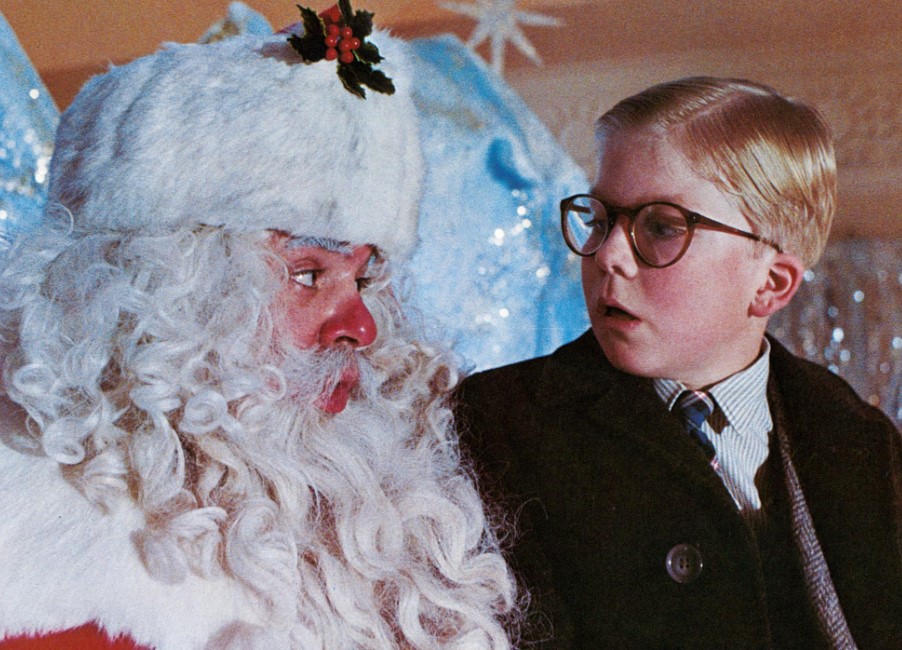
In Christmas films that are aimed at kids, Santa Claus is usually a benevolent and kind figure (and in some cases the genuine article). He receives children selflessly and his presence brings much joy and excitement. Not so in A Christmas Story. The Higbee Store Santa is a red-nosed shithead who can’t wait to clock off, presumably with an eye on making that nose redder in the nearest bar. His elf helpers are not much better. They exude malevolence as they drag kids up the stairs, muttering “hurry up” before hurling them across Santa’s lap. After having “HO HO HO” shouted in their face, most kids let rip with a blood-curdling scream and are thrown down a slide.
When Ralphie arrives at Higbee’s Store he’s desperate to get to Santa to ask for the beloved BB Gun. After Ralphie and Randy get in the queue, what follows is hilariously depressing and would probably put most kids off men in red suits for life. Firstly they are in line with a creepy kid who stares at Ralphie through aviation goggles. When our hero finally makes it to not-so-jolly Saint Nick’s lap, he freezes and can’t remember what he wants. Sheer terror does that I suppose. When he’s thrown down the slide after an elf bellows at him to “HURRY UP”, Ralphie suddenly remembers and, whilst crawling back up the slide, tells Santa he wants a BB gun. Santa tells him he’ll shoot his eye out and boots him in the head.
A small detail I love here is when Ralphie lands at the bottom of the slide, he encounters Randy just lying there with a thousand yard stare. You suspect Randy will be talking about Santa to his future therapist for many years to come.
Kids make crappy friends
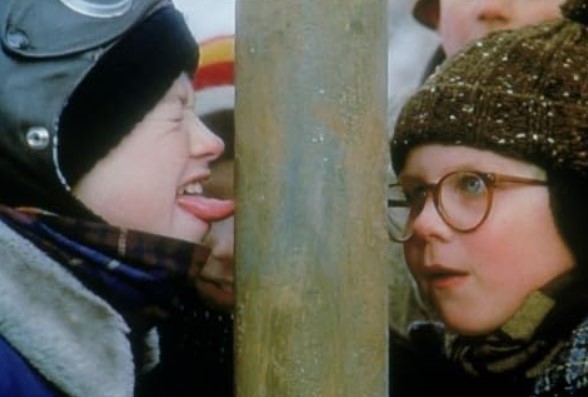
This is not to say that Ralphie, Flick (Scott Schwartz) and Schwartz (R. D. Robb) are not genuine friends. They are all good buddies who live on the same street and have known one other their whole lives. What A Christmas Story gets right is that certain things in a kid’s life override friendship rules, namely the school bell ringing. When Flick sticks his tongue to a frozen flag pole after being Triple Dog Dared by Schwartz, the terrified Flick has to watch as his friends run back to school when the bell rings, screaming “don’t leave me, come back!”. They don’t even tell the teacher, she has to discover Flick’s predicament when another pupil points at his flailing form outside of the window.
A similar scenario occurs when local terror Scut Farkus (Zack Ward) grabs Flick in the playground and on hearing the school bell, the others flee and leave him to his fate. We next see Flick sullenly entering the classroom late with a black eye. The teacher merely glances at him and continues with the lesson.
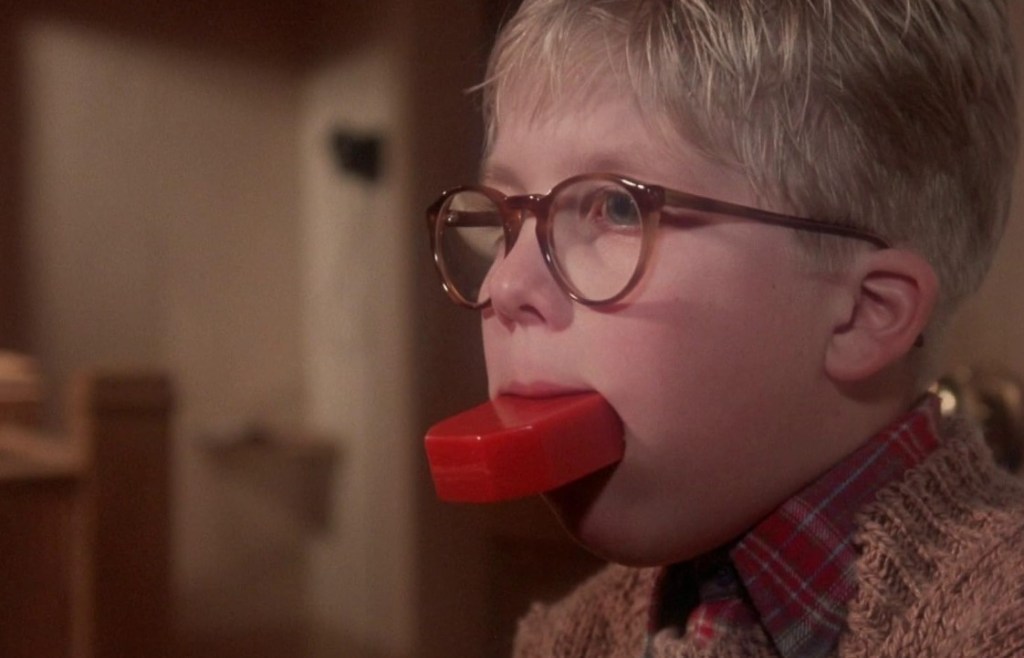
Self-preservation is another motivation when throwing a friend under the bus. Ralphie drops the f-bomb within ear shot of The Old Man and has a Lifebuoy soap shoved in his mouth as punishment. His mother wants to know where he learnt that word and even though he hears The Old Man letting rip with the word on a daily basis, Ralphie names Schwartz. Cue a phone call and the sound of a bewildered Schwartz being torn a new arsehole by his mother.
None of these occurrences result in a revaluation of behaviour, soul searching or any consequences. Life just continues.
Ralphie’s fantasy sequences
When he feels he has been wronged or believes his quest for a BB gun is a righteous one, Ralphie will disappear into daydreams. With their soft lighting and dramatic delivery, you could say these interludes share some parallels with dream ballet sequences except there’s no dancing and they don’t function to move the plot forward. They simply exist to give an insight into Ralphie’s brain at that moment in time.
I love all of the sequences but my personal favourite is after Ralphie has his mouth washed out with Lifebuoy soap. He imagines returning to the homestead as a blind man and his family being horrified at his predicament. He nobly tries to shield them from the cause of his condition before admitting it was “soap poisoning”. Cue the family wailing and clinging to him as they lament the error of their ways. Ralphie then looks up and smiles at the camera. A scenario where someone would wish the actual loss of their sight in order to teach their parents a lesson is so realistic for a child that I wondered if this was one of Shepherd’s own memories.
Ralphie’s daydreams are unapologetically self-centred and in a lesser film this narrative device could have alienated the viewer. In A Christmas Story I feel it has the opposite effect. An interesting fact I picked up from Billingsley’s podcast was that another daydream sequence featured Ralphie fighting in space to save Flash Gordon (sadly the footage is lost but some photos exist). According to the podcast episode, this scene was cut as it was considered a little too much when compared to Ralphie’s other fantasies which were more localised. I think this encapsulates why the sequences work. A child’s world is small, it revolves around home, school and the neighbourhood. Ralphie’s daydreams are a product of this but they have the effect of widening his world to the viewer by giving a glimpse into his interior life.
Little Orphan Annie
I have to give Little Orphan Annie a mention as even a sweet little girl doesn’t escape Jean Shepherd’s quiet skewering of the nostalgic. This was the 1940s so the radio was the main source of entertainment in the Parker household. Ralphie is an avid listener to the Ovaltine sponsored Little Orphan Annie radio show and saved up for a long time to receive her secret decoder, allowing him to finally understand her weekly messages.
Ralphie decamps to the bathroom to decode his first secret message (the only place in the house where he has total privacy). He is so excited that he ignores the pleas of Randy who is literally about to piss himself outside of the door. Finally, he reads back Annie’s secret message: BE SURE TO DRINK YOUR OVALTINE.
That a child has been encouraged by a radio show sponsor to drink gallons of their product in order to save up tokens is one thing. To then use the prize to push a disguised commercial which encourages the drinking of more Ovaltine is sublime.
The Bumpus’s dogs
The Bumpus family are the never-seen neighbours of the Parkers. We only get a sense of them through their marauding hounds who harass The Old Man particularly when he returns from work. The sound of barking and The Old Man shouting as he fights off the dogs lets the Parkers know that poppa is home.
They really come into their own on Christmas Day. After a dramatic moment with Ralphie and his BB gun (he nearly does shoot his eye out), The Old Man settles in a chair to read the newspaper. The Bumpus’s hounds file past unseen into the kitchen and decimate the turkey. Following this moment of Christmas destruction The Old Man chases out the dogs, screaming “SONSABITCHES” and “BumpuSES” out of the smashed in screen door. He then tells the family to get dressed as they’re going out for dinner. The Parkers then have what is described as a feast at their local Chinese restaurant.
The dogs get an honourable mention as this moment has been foreshadowed throughout the film. So much so that The Old Man has a kind of resignation and eerie calm following the rampage. The voiceover from Jean Shepherd is wonderful at that moment – “Ah, life is like that. Sometimes at the height of our revelries, when our joy is at its zenith, when all is most right with the world, the most unthinkable disasters descend upon us”.
There are many other examples I could give such as Ralphie lying (and getting away with it) so he can keep his BB gun and the moment when Ralphie’s mother leaves a bleeding Scut Farkus lying in the snow after Ralphie finally stands up to him. You’ll just have to watch it to really get the sense of its brilliance.
It is worth noting that despite my total agreement with Shepherd that the absence of sentimentality or pushing of a Christmas magic/miracle narrative is a strength of this film, that doesn’t mean it lacks warmth. Quite the opposite – A Christmas Story has warmth in spades. It is evident in the Parker family home with its soft interior lighting (some of which is provided via the ‘electric sex’ lamp) and in the interactions Ralphie has with his friends and family. The late, great Roger Ebert articulated it perfectly when he said Ralphie’s parents were the nicest he could remember in a “non-smarmy movie”. The family clearly love each other but this is demonstrated through the everyday rather than a grand narrative arc.
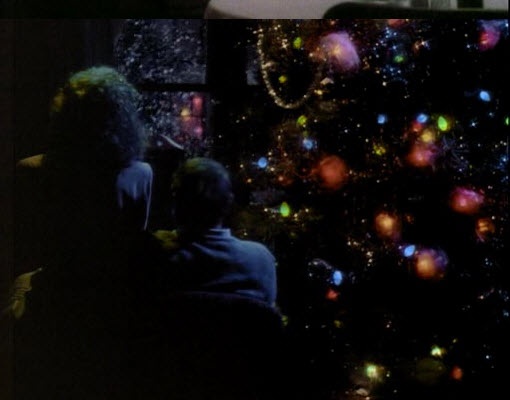
The films draws to an end as Ralphie and Randy are asleep in their beds, cuddling their toys. Mr and Mrs Parker are downstairs with a glass of wine and, on seeing it snowing outside, settle next to the window to watch. This is probably one of the sweetest parts of the film but I think Bob Clark’s choice of ending still refuses to tip into the mawkish. Getting through Christmas Day with everyone content at the end is a modest hope. The couple’s toast as the film closes is a tender moment but one of relief, they have a survived another Christmas. A sentiment to which many of us can relate.
Next time: the best films of 2024
View from the Ferris wheel – what I’ve been watching…
The Taste of Things (2023), Berkhamsted Film Society screening – Trần Anh Hùng’s sumptuous drama is a feast in every aspect of the word. During the cooking scenes you can almost smell the aromas and the finished dishes made me very hungry. Amongst the incredible food is a gentle love story between Eugénie (Juliet Binoche) and Dodin (Benoît Magimel) which brings it all together.
The Apprentice (2024), The Rex in Berkhamsted – this a remarkable piece of work which I liked a lot more than I expected. Sebastian Stan as Donald Trump and Jeremy Strong as Roy Cohn are both powerhouse performances. Director Ali Abbasi tells Cohn’s story almost as Shakespearean tragedy and it’s all the better for it. I recommend seeking Abbasi’s previous films Holy Spider (2022) and Border (2018) as well as this one.
That Christmas (2024), BFI Southbank – this Richard Curtis animation is available on Netflix but I was lucky enough to see it in the cinema as a staff screening for our Christmas/winter party celebrations. This is actually good fun and fine for family viewing over the break. Script is a bit ropey in places and the sentiment is layered on thick but still very enjoyable.
All We Imagine as Light (2024), BFI Southbank – written and directed by Payal Kapadia, this is an impressive film which tells the story of three female nurses working in Mumbai. Dreamlike and thoughtful, it’s a deeply felt film which I’m already planning on seeing again when it drops on the BFI Player platform in January.
Iris (2001), BFI Southbank – screened as part of the Richard Eyre season, this came with an insightful intro by Professor Lucy Bolton. As a fan of Iris Murdoch’s work, I enjoyed this but it’s an uncomfortable watch. It’s unflinching in showing the decline of Murdoch’s incredible mind but never feels gratuitous. Very good performances by Judi Dench and Kate Winslet as Murdoch over two life stages.
Scrooged (1988), Amazon Prime – next to The Muppet’s Christmas Carol, this is one of my favourite adaptations of A Christmas Carol. Bill Murrey’s soulless television exec, Frank Cross, is one of Christmas’s best villains. Watching the Ghost of Christmas Present kicking the shit out of him never gets old.
The Trouble With Jessica (2023), Berkhamsted Film Society screening – this was hard work. What could have been a darkly amusing premise ends up being a weird mish-mash of messages about rich liberals and their morals. The script is pretty dull relying on copious swearing for laughs. Shirley Henderson’s performance was fantastic but couldn’t really save it.
Conclave (2024), The Odyssey in St Albans – Edward Berger’s thriller set during the election of a Pope is far more interesting than it appears on paper. Gripping from the beginning with excellent performances from Ralph Fiennes, Stanley Tucci, John Lithgow, Lucian Msamati and Carlos Diehz, this is a masterclass in intrigue and complex character studies. The cinematography and use of colour are striking. Very much recommend.
Carol (2015), Mubi – a gorgeous film by Todd Haynes which deserves its place in the Christmas film canon. New York in the 1950s is brought to life through the stunning production design and wardrobe. Cate Blanchette and Rooney Mara are just bloody wonderful as two women falling in love in a less than tolerant society. It’s one of my must-watches over Christmas and love it more with each viewing.
Christmas film all-night at the Prince Charles Cinema, London:
A Muppet’s Christmas Carol (1993)
Elf (2003)
Home Alone (1990)
Gremlins (1984)
Die Hard (1988)
My favourites were Die Hard and Gremlins but honestly they’re all great and should be watched every year.
Wallace & Gromit: Vengeance Most Fowl (2024), BBC – watched with my mum on Christmas Day and the folks at Aardman and Nick Park do it again. An absolute banger and a joy to watch. Catch it on BBC iPlayer if you missed it.
 The Cuckoo Clock Film Blog