Contains spoilers
This post that you’re (hopefully) about to read was actually written in spring 2020 when we were in the midst of a global pandemic and lockdown suddenly gave me the headspace to start writing about film. I wasn’t sure if I would publish it but the ending of a favourite film podcast last week, which has been my frequent companion over the previous few years, has compelled me to dust it off and give it an airing.
The I Saw What You Did podcast entered my life when it launched in November 2020 and the Apple algorithms were clearly on point when the recommendation slipped into my feed. Seeing that it was fronted by women was the initial draw. I have been a keen consumer of film writing, criticism and commentary for a long time and there are some amazing, outward looking commentators (RIP Philip French) whose work I respect and appreciate very much. Unfortunately it is a very white male dominated area and to see two women, particularly two women of colour, entering the fray was an appealing prospect. After the first couple of episodes, I wondered how the hell I had managed without them.
Danielle Henderson and Millie De Chirico are clever, insightful and funny. When I say funny, I mean laugh-out-loud-on-public-transport-and-getting-weird-looks funny. The premise is they pick a theme (which is always brilliant but impossible to guess – examples being “Baby girl, what is you doin’?” and Christmas Assholes) and they each choose a film related to it. The results are two random films which are intelligently, and hilariously, discussed each week. A large part of the podcast’s appeal is Millie and Danielle themselves. As listeners we have experienced their highs, lows and major life changes. I’m sure I’m not alone when I say that their half hour discussion on how they’re both doing at the start of each episode is a highlight. As a British person, I have to also comment that the fact these two whip-smart American women are anglophiles warms my cockles no end.
The podcast is ending in the greatest possible way – Danielle’s writing career is thriving and Millie is involved in several other projects plus she’s in discussions around hosting another podcast. I’m bereft at the loss, Millie and Danielle feel like friends and I had been waiting for film commentators like them for a long time. That they’re going out on a high is a perfect ending and I look forward to seeing them flourish in the future. All the back episodes will remain available to listen to and I’m already working my way through them again. I urge you to seek them out if you haven’t listened already and if you subscribe, Millie’s new project will drop on the same feed.
The reason the podcast led me to releasing this blog post is due to the duo covering the film in an early episode. I watched Reality Bites (1994) for the first time in April 2020 and, as an adult, was horrified at the character of Troy Dyer (Ethan Hawke). I admit some of this post was written a bit drunk and enraged and I wondered if I was the only one who thought Troy was a Grade-A wanker who women should steer well clear of. Then an episode dropped on 15th December 2020 called Horrible Choices Abound which had the theme Classic Movie Fuckboys. They covered Hubbell Gardiner (Robert Redford) in The Way We Were (1973) and, to my delight, Troy Dyer. To use modern day parlance, I felt seen.
I’ve edited some parts of my original post but it’s more or less presented here how it was written, so let’s go back to 2020…
Reality Bites was released in 1994 and at that time I would have been 14 or 15. I remember the hype well and the runaway hit from the soundtrack, Stay (I Missed You) by Lisa Loeb, was playing everywhere. It’s a mystery why this film bypassed me.
For the uninitiated, the film follows four twenty-somethings who are navigating life after finishing college. Using her own experiences from a close friendship group, Helen Childress wrote the script and reportedly went through 70 different drafts before working with the director, Ben Stiller, to develop it for filming, I finally sat down and watched it during the early stages of Covid-19 lockdown in April 2020.
My first impressions were favourable. It took me back to a time in my life when I had finished my media and film studies degree, had a temping job in admin and was house sharing with friends. It was a confusing and anxious time and I was figuring out what I wanted to do with my life. It became quickly evident that my weekend job as a volunteer Broadcast Assistant with a local BBC Radio station was unsustainable if I wanted to pay rent and bills. It was also a lot of fun. Life was fairly uncomplicated and filled with great nights out and even better nights in.
The friendship between the four Generation X friends, Lelaina (Winona Ryder), Troy (Ethan Hawke), Vickie (Jeneane Garofalo) and Sammy (Steve Zahn) captures this post-graduation moment too. Lelaina and Vickie move into a flat and while Vickie is helping women get kitted out in double denim at The Gap, Lelaina is a production assistant for an obnoxious morning TV host (a wonderful John Mahoney). Soon Troy manages to get himself fired for the umpteenth time and ends up crashing on the women’s sofa, reigniting his sexual chemistry with Lelaina.
I revisited the film again shortly after the first watch and whilst it was still the cosy nostalgia trip I recalled from my first viewing, there were a couple of things I took issue with this time around. For one, Zahn’s Sammy, who is preparing to come out to his mother, is barely on screen. It’s a shame we know so little about his character. His self-imposed celibacy whilst he waits for his mother’s acceptance is genuinely interesting but is treated as a side-note and left largely unexplored.
The biggest honking issue of the film was Lelaina choosing to be with Troy when faced with the choice between him and nice but dull corporate dude, Michael Grates (Ben Stiller). Were it my choice, she would have ended up with neither of them, choosing instead to continue hanging out with Vickie and keeping her options open. My second viewing had me horrified that she ends up with Troy. This is not because he’s the college dropout of the group, or even because he’s apparently incapable of holding down a job. Simply put, he’s horrible. Troy is the poster boy for every entitled, pretentious, narcissistic man-child you ever encountered in your 20s – and probably beyond. When he moves in with the two women (unannounced, might I add), he never thanks them. He has the air of someone who believes he is doing them a massive favour by allowing his unwashed form to create an arse-groove in their couch.
Troy’s true colours emerge when Lelaina begins dating TV executive, Michael. After seeing them kissing in a car, he thinks it’s completely acceptable to wait in her living room in complete darkness, only illuminating his malevolent form with a lamp when Lelaina enters the room. He immediately begins slut shaming her. When she reasonably asks what the hell it has to do with him, Troy slowly walks towards her, cups her face in his hands and tells her he’s in love with her. He then laughs in her face.

I’d love to say that this was the worst example of Troy’s charm offensive but sadly not. He’s unbelievably rude to Michael when arrives to collect Lelaina for another date. I don’t mean a bit off, like we all can be when someone is knocking boots with the object of one’s affection. He is full on hostile and contemptuous, assuming that Michael is stupid and superficial. Troy, of course, completely misses the point that to insult Michael is to insult Lelaina and her judgement. Which in choosing someone other than him, is pretty much spot on.
Speaking of stupid, Troy is portrayed as a thinker and an artist. We know this because he’s in a band (called “Hey, That’s My Bike” – annoyingly, I quite like that name) and he reads big books. There is a reference to his IQ being 180: he smugly tells Michael that there’s an “IQ prerequisite” when talking to him. Clearly a high IQ is no barrier to being a twat (QED James Woods, reported IQ of 180).
Troy has an innate belief in his superiority to those around him, reinforcing the idea that he, more than anyone, knows what is best for Lelaina. This of course manifests itself through negging. When Michael arrives at the flat to take Lelaina to the premier of her video at his TV network, he naturally encounters the creepy couch Gollum. When Lelaina emerges in a dress – which looks pretty damn lovely – Troy is all “what happened to your normal clothes?” His coup de grace is saved until just before she leaves. On the biggest night of her career, he tells his best friend and love interest that she looks like a doily.
Further fuckwittery arrives when Troy randomly kisses Lelaina and then throws a tantrum because she wants to be faithful to Michael. I mean, what a bitch. Following this inspiring encounter, he disappears from their flat for a few days and when Lelaina next sees him and tries to reconnect, his response is to look up from his Big Book of Pretentious Bollocks and tell her that her bravado is “offensive” and storm off. There’s several things offensive about this exchange. Lelaina’s so-called bravado is not one of them.
Of course Lelaina eventually sleeps with Troy and of course he runs out on her. OF COURSE he gets a cob on when she turns up at his gig and Michael arrives. He’s annoyed because he really wanted to talk to her and thought they could work it out, because all of her decisions and movements simply must be considerate to him. In case you’d forgotten, Troy is the victim here. This scene ends with his gruesome form on stage dedicating the next song to Lelaina. Cue him bellowing out his lyrics and staring at her in a manner that would have most women reaching for their handbag mace.
This finally brings me to one concession: it’s important to be fair and put Troy’s age into context. Very few of us were upstanding citizens when we were in our early to mid-20s. We lashed out due to insecurity or suchlike and perhaps said horrible things to undeserving people. I freely admit to being a complete dickhead and was nowhere near as clever as I thought I was. But even with this in mind, it’s hard to cut Troy much slack. The characters of Lelaina and Vickie – I can’t include the criminally underused Sammy – are endearingly self-absorbed and throw a few barbs each other’s way but you never think they’re not nice people. I can absolutely imagine hanging with them and singing Tempted by Squeeze at the top of our lungs. I would join them in dancing to My Sharona in a petrol station and would love board game nights with them. Troy is the overly earnest Bernie-bro, causing the group to nearly eye-roll themselves to death when he takes out his acoustic guitar for 4285th time.
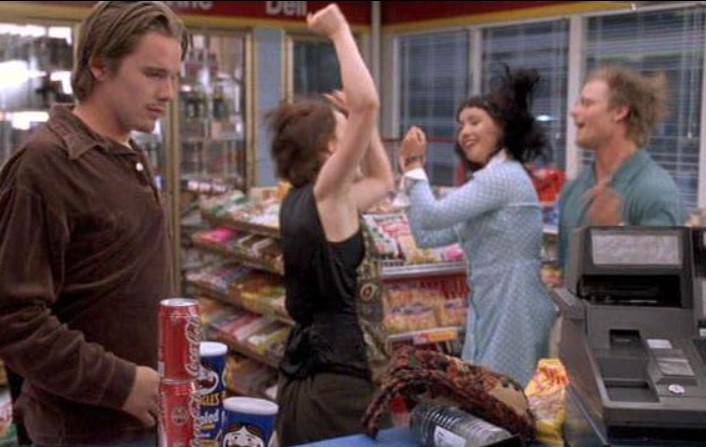
Despite all this, I will try to end on a semi-positive note. There are hints of contrition in Troy when he returns from his dad’s funeral and he genuinely cuts a humbler figure when finally telling Lelaina how he feels about her. What he doesn’t do is apologise or address the notion that maybe he was a terrible friend who frequently disregarded her feelings and life choices unless they were approved by him. Still, there were times when Lelaina stood up to him magnificently and it’s important to note that the film has other interesting moments (namely Vickie’s HIV test storyline), which don’t involve Troy.
I have sometimes wondered what becomes of Troy and Lelaina after these events. I suspect they last a couple of years, he becomes increasingly threatened by her success as a filmmaker and she finally leaves him. I like to imagine Lelaina and Vickie meeting up in Houston in their 30s and reminiscing over a couple of beers. They share a laugh recalling the time Troy would sneak his ropey boxer shorts into their laundry and then fall silent for a couple of seconds. Lelaina, pondering into her beer, suddenly looks up and says “he really was an asshole, wasn’t he?”
View from the Ferris Wheel:
Reading:
The Shining by Stephen King – I generally leave out what books I have on the go but mentioning this King classic as I watched the Kubrick film with a friend over Halloween. After a discussion I realised I’ve never read it so duly picked it up from my local library. Bloody hell, it’s good. Kubrick’s version was very different and I still love it but the book is incredibly unsettling and atmospheric. The gradual awakening of the spirits at The Overlook and the impact on the family really gets under your skin and feels very much like folk horror in places.
Watching:
Anora (2024) at BFI Southbank – to say I love Sean Baker’s newest film would be an understatement. I’ve been a fan of his since Tangerine (2015) and The Florida Project (2017). His knack of showing complex characters on society’s fringes with empathy is really something. Mikey Madison is luminous in this and I hope to see many award nominations coming her way.
Terminator 2 (1991) at BFI Southbank – part of the BFI’s Art of Action season (which has been incredible). Each time I watch this, I’m envious of those audiences who got to realise live-time that Arnie’s Terminator was the good guy when John Connor first encounters him. My friend and I got nicely drunk after the screening, blabbing on about how great it is. We were not massively convinced by the remastered version though, I personally prefer the graininess.
Gladiator II (2024) at Hatfield Odeon – this was entertaining enough although would have been a duller film without Denzil Washington’s Macrinus (I want to hiss “that’s politicssssss” at everyone). Paul Mescal as Lucius isn’t bad although he interacts with characters like he wants to get off with them. Some impressive fight scenes although not as crunchy as the first film.
Reality+ (2014) on Mubi – I’m catching up with some Coralie Fargeat films to ready myself for The Substance (2024). This is a short film about a future where a chip can be implanted in your brain and for a 12 hours a day you can look more attractive but only to yourself and others with the implant. This was interesting and from what I know of The Substance, some foundations were laid here.
Revenge (2017) on Mubi – another Coralie Fargeat film. Jen (Matilda Lutz) is on a romantic break with her married boyfriend, Richard (Kevin Janssens). All seems idyllic until his two hunting buddies arrive and things take a darker turn. Abused and left for dead, Jen turns the tables. This is a cracking little film – shot in the sun-drenched desert, it’s an ultra-violent, visceral revenge thriller.
Starve Arce (2023) on BFI Player – I enjoyed the book by Andrew Michael Hurley and British folklore is a big interest of mine (particularly when hares are involved). This had two great performances (Morfydd Clark and Matt Smith) and was shot beautifully on location in Yorkshire. It sadly fell a little flat for me and I didn’t love the altered ending. It just wasn’t very unsettling and lacked the ambiguity that, to me, is the crux of many folklore tales.
Emilia Pérez (2024) at The Rex, Berkhamsted – this is available on Netflix but I wanted to see it in a cinema. I’m glad I did as it became very clear early on that I was watching a 35mm print. It’s a terrific film with superb turns by Zoe Saldaña, Selina Gomez and Karla Sofía Gascón. I’m not normally a musical person but this really grabbed me, the numbers are well staged and blend in with the general flow of the film.
Seven Samurai (1954) at BFI Southbank – my second outing of watching all 207 minutes of Akira Kurosawa’s epic. Kyūzō’s (Seiji Miyaguchi) stoic, unflappable swordsman still remains my favourite character. Despite the runtime, nothing feels unnecessary and I can’t imagine ever tiring of seeing it on the big screen.
Face/Off (1997) at BFI Southbank – more from the Art of Action season and projected on 35mm film, this John Woo classic is so stupid and so entertaining. I could happily watch it every week. Nicolas Cage is obviously my dude but I really enjoy John Travolta’s performance as Castor Troy/Sean Archer. The experienced was heightened by a few drinks before and a very lively audience.
Next time: A Christmas Story (1983)
 The Cuckoo Clock Film Blog