Contains spoilers
I love Halloween. I really dig autumn and all of its associated colours so pumpkins fit in great – although pumpkin spiced lattes can get in the sea. What’s more, despite leaning towards the sceptical, I have a healthy interest in folklore and the supernatural. Around this time of year the nights draw in and it’s the perfect time to read ghost stories and re-watch some classics. I’ve recently revisited The Shining (1980) and Carrie (1976). For an audio hit, I dived back into Julian Simpson’s The Lovecraft Investigations and the Radio 4 production of Nigel Kneale’s The Stone Tape. Danny Robins’s Uncanny podcast has rejoined me on my walks to work to make those misty mornings a little more sinister.
Whilst the John Carpenter classic Halloween (1978) is understandably associated with the season, it’s not a film I revisit all that often. The last time I watched it was back in 2022 with a friend and it was part of a double bill with Halloween (2018). The latter film quite rightly ignores the many sequels in the franchise and is a present day follow-on from the events in 1978. It was good fun and I’d recommend the two films for a slasher night in.
What inspired me to write about the 1978 classic was the character of Dr Sam Loomis, played by film and television legend Donald Pleasence. Loomis has always fascinated me as he is both the authoritative voice of reason and totally useless. His complete lack of empathy or hope for Michael Myers is hilarious until you remember that he was and is responsible for his rehabilitation.
I can’t imagine any other actor than Pleasence playing Loomis – the solemn doctor with his serious proclamations and frustrated rants had to be played straight. Pleasence lent a credibility to Loomis which in the hands of another actor might have tipped him into caricature. My fascination with the good doctor is that his words and actions are two entirely different things and each time I watch Halloween I find him more and more baffling.
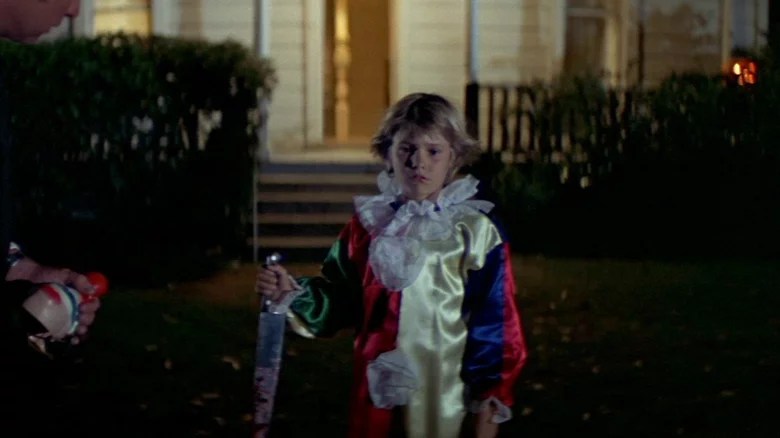
The film starts with a flashback from Halloween night 1963 in Haddonfield, Illinois. This is a great set up: our view point is via young Michael Myers who watches his sister, Judith, getting very friendly with a boy on the sofa. They head upstairs and Myers continues to lurk around the house. The gent leaves duly satisfied after what feels like a minute and we see Myers slowly ascending the stairs, donning a mask he finds discarded on the floor. He finds Judith brushing her hair in her undies and stabs her to death. She sexily caresses her breasts whilst expiring, probably realising that the 60-second wonder who just left the house was really not worth this grisly end. The view changes to a wide shot of the home’s exterior as Myers, a little boy dressed as a clown and holding the bloody knife, is confronted by his parents. Seriously brilliant opener. Chapeau, Mr Carpenter.
It’s now the 30th October 1978 and Dr Sam Loomis and nurse Marion Chambers (Nancy Stephens) are driving to a psychiatric hospital to collect a now adult Myers for a court appearance. Things do not start well when Loomis refers to Myers as “it”. When Chambers points out that perhaps “he” might be more appropriate, Loomis all but shrugs at her. As they approach, the hospital starts to resemble a market town after pubs have called last orders as patients are wandering the grounds confused and directionless. Despite the horrendous weather and the danger these patients might be to themselves or others, Loomis leaves Chambers alone to open the gates. Predictably she’s attacked and thrown from the car. As the assailant drives off, Loomis helpfully declares that “the evil has gone”.
A big question is – how the hell did Myers learn to drive? There is a small attempt to answer this question in a later scene when Loomis is berating a hospital manager and suggests that someone must have given him driving lessons. The idea that a dangerous patient in a high security facility could be casually taken out for driving lessons is laughable but, having said that, I sincerely hope someone has filmed a version of the teenage Myers taking said lessons.
Loomis quickly and rightly figures out that Myers will head back to Haddonfield. It’s these early appearances in the town which foreshadow Myers’s superhuman qualities later on in the film, and indeed the franchise. We are introduced to Laurie Strode (Jamie Lee Curtis) who is the daughter of the estate agent charged with selling the old Myers murder house. This is an unenviable task as the locals think it’s haunted and the building itself looks deranged.
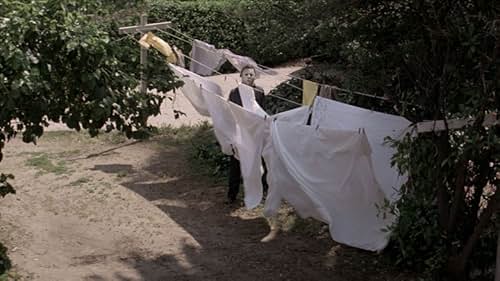
Myers begins stalking Laurie from the off. She sees him staring at her across the road when she’s in class, he steps out from behind a hedge in the distance as she walks home with a friend and (my personal favourite) stares at her through her bedroom window whilst amongst some billowing sheets on a clothes line. What unites these occurrences is that Myers seems to have an uncanny ability of not only knowing where Laurie will be but also the exact moment when she’ll look over. He can also disappear into thin air when attempts are made to find him. This suggests Myers either being in Laurie’s imagination at this point or him possessing superhuman powers. I quite like the former theory, even if it only makes sense when Laurie’s connection to him is revealed in Halloween II (1981). We’re not here to discuss Laurie though, so let’s catch up with Loomis.
Loomis is driving the 100+ miles to Haddonfield and on route he stops in the middle of nowhere to use a payphone and shout at the police. This is a weird scene – he tells the police they must be ready for Myers’s arrival or “it’s their funeral”. You’d think Haddonfield’s finest officers would know exactly who Myers is and be ready for him but no… Loomis then views an abandoned mechanic’s truck and we are to assume that this is work of Myers. He then sods off without giving the area a search but a camera pan to the right shows the audience a very dead man in the bushes. Nice work, Loomis. I guess that’s where Myers got his boiler suit from.
When Loomis arrives in town, he pays Judith Myers’s grave a visit and finds that the entire tombstone has been lifted out of the earth. His guide mutters something about kids doing anything for Halloween, Loomis just adopts his now frequent thousand-yard stare proclaiming Myers has “come home”. This is of course another nod to the superhuman strength Myers may or may not possess but it’s also an indication of how in denial this small town is about this blood-soaked chapter of their history. The cemetery guide even mentions how every town has had something like this happen. I’m pretty sure most town histories do not include seven-year-old boys in clown costumes shanking their promiscuous sisters. The police are not much better.
Loomis locates Sheriff Brackett (Charles Cyphers) outside of a hardware store which has been broken into. There’s a great part of this scene when Loomis is looking around nervously, presumably for Myers, and fails to see Myers drive right past him in the psychiatric hospital car. The Sheriff has already quipped that some rope, knives and Halloween masks have been taken and kids are blamed yet again. The fact that they have been warned that a homicidal maniac whose doctor literally calls “the evil” is heading their way does not appear to be ringing any alarm bells. Nice work, Sheriff Brackett. I guess that’s where Myers got his mask from.

Loomis manages to persuade the Sheriff to accompany him to the old Myers house. He assumes the role of a macabre tour guide, showing the Sheriff exactly where Judith was murdered, it’s at this point that a rock flies through the window and Loomis pulls a gun. We now know he’s packing heat and having already dropped a Chekhov joke in a previous post, I won’t repeat myself. It’s worth mentioning this part of the film as this is where things shift and Loomis becomes the looming doctor of the title. After explaining that Myers has no sense of right and wrong and is dead behind the eyes, he refuses to let the Sheriff call it in. Instead he tells him the police should keep their “mouths shut and their eyes open”, which makes no sense. In response to this weird advice, the Sheriff agrees to come back in hour.
Meanwhile, Myers is stalking Laurie and her friend Annie. He murders a dog and stares at people through windows, all building up nicely to his eventual slaying of Annie and Laurie’s other friends, Lynda and Bob. Whilst some of this is occurring, Loomis is hiding in a bush and terrifying children who approach the Myers house. The Sheriff comes good on his promise and checks in but seems to have forgotten everything mentioned before telling Loomis nothing is happening and he needs more than “fancy talk” to prove that Myers is a danger. Like a raincoat clad Cassandra, Loomis declares “death has come to your little town”. The Sheriff decides this is more “fancy talk” but agrees to stay with him. So now they’re both hanging out in the bushes waiting for Myers to finish whatever he’s out doing (such as making death come to this little town) and head home.

I recall at this point wondering about Loomis’s actions. The nonchalant police show them to be inept but they also hark back to the cemetery guide and a town in denial. This has a ring of truth and a town’s wilful amnesia over a traumatic event is not only interesting but a clever thing to tap into. Loomis on the other hand has not forgotten and to see him switch from demanding police action in one scene to being a weird bloke obsessively looming in a bush is quite the about face. It’s the third act of the film which started to piece things together for me.
He’s galvanised into action when he turns his head slightly and spots the psychiatric hospital car that was pinched by Myers parked across the street. Despite having one job, Loomis did not spot this car or hear it pulling up. This at least gets him out of the bush and wandering the streets in search of Myers. Thankfully Laurie is an incredibly resourceful final girl and Loomis finally discovers the whereabouts of Myers after some kids flee screaming from a house. Laurie has dispatched them to call the police after skewering Myers in the eye with a coat hanger. Cue the iconic scene when Myers, apparently dead in the background, sits bolt upright. It still holds up to this day as a truly chilling moment. Loomis appears and unloads the pistol he’s been packing into Michael’s chest, throwing him through a first floor window. We share Loomis’s viewpoint as he stares down at Myer’s body and after comforting Laurie he checks the window again to find Myers gone.

It was Loomis’s stare into the middle distance at the end which made the penny drop. He wasn’t surprised Myers had escaped. Prior to discovering that Myers had fled, he’d confirmed to Laurie that he was the boogieman bringing the idea full circle that Myers is somehow beyond human. Carpenter had already been dropping hints throughout the film and Loomis’s actions are increasingly that of a man who understands this. They are also the actions of a man emulating a distinct personality trait shared with Myers: a single-minded focus on an individual.
During an interview on the set of Halloween, Pleasence is candid about not loving the script, especially due to it having people behaving in ways that “people can’t possibly in real life behave”. Pleasence also astutely notes that his role is not meant to be real or realistic. It think this is perhaps the crux of Dr Sam Loomis: he believes Myers to be damned and with his obsessive belief in his evil almost damns himself. He becomes monomaniacally focused on his target and ignores the consequences. It at least goes someway to explain why Loomis hangs around in bushes at the old Myers murder house rather than actually doing practical stuff to find him. Whatever he does to try and stop Myers, as we now know, is doomed to fail.
A quick browse through the plotlines in future Halloween films suggests that Loomis becomes even more mad and obsessed, which is not surprising when your life’s work is to kill the unkillable. I still maintain Pleasence is great in this film, his actions sometimes make no sense but as I came to realise, perhaps they’re not meant to.
View from the Ferris wheel:
Due to the quick turnaround between posts, the only film I’ve seen in the cinema is Tim Burton’s Beetlejuice Beetlejuice (2024), this was a lot of fun and great to see Michael Keaton and Winona Ryder back in their respective roles. If you loved the original (which is currently on Netflix) then the chances are you’ll like this.
Instead, here are some book, film and podcast recommendations for this spookiest of seasons:
Books
Starve Acre by Andrew Michael Hurley
Hare House by Sally Hinchcliffe
We Are for the Dark by Elizabeth Jane Howard and Robert Aickman
A Helping Hand by Celia Dale
The Haunting of Hill House by Shirley Jackson
The Demon Lover by Elizabeth Bowen
Beloved by Toni Morrison
Pretty much anything by Arthur Machen and M.R. James
Film/Television:
Robin Redbreast (Play for Today directed by James MacTaggart, 1970)
Ghost Stories for Christmas (available on DVD and Blu-ray – contains various adapted stories including The Signalman and Warning to the Curious)
Ringu (1998, dir. Hideo Nakata)
The Wicker Man (1973, dir. Robin Hardy)
The Exorcist (1973, dir. William Friedkin)
Kill List (2011, dir. Ben Wheatley)
Children of the Stones (British children’s TV series broadcast in 1977)
Beasts (British TV series written by Nigel Kneale, broadcast in 1976)
Podcasts:
Uncanny written and presented by Danny Robins
Ghosts in the Burbs written and presented by Liz Sower
The Lovecraft Investigations written by Julian Simpson
 The Cuckoo Clock Film Blog