Contains spoilers
I’ve had to have a rethink about how I go about this as since I started this odyssey Cage has made another three films* and, according to IMDB, he has 6 films and a TV series in production or pre-production**. If he keeps up this run and I do a single post each time then the joke about me dying before completing this task (see Cageathon #1) will come true. I’ll barely make it to The Wicker Man (2006) in one piece and I really want to make it to The Wicker Man.
The plan is to cover three to four films at a time with each film having a brief synopsis of the plot and the role played by Cage. The focus will then be the essential features of the film such as “best Cage Rage moment”. I have several potential questions to cover for each post and won’t necessarily use the same ones for each film. It helps to keep them interesting plus some of Cage’s films are completely bat-shit so unique takes are often required. I may still do the odd post on a single film should the need arise.
*Arcadian (2024), Longlegs (2024) and The Surfer (2024)
**The TV series being made is 8 episodes of Spider-Noir. For those of you who loved Spider-Man: Into the Spider-Verse (2018) (and if you didn’t, what the hell is wrong with you?), you will recall the Cage doing an excellent Spider-Man Noir voice. I am beyond excited about this series.
So, I’m kicking off the new format with the next three films starring young Cage. It’s probably a total coincidence but they’re all period pieces spanning three quite different decades of the 20th Century. Let’s start with the 1940s…
Racing with the Moon (1984) directed by Richard Benjamin – plays Nicky
It’s December 1942 and Hopper (Sean Penn) and Nicky are counting down the days in their small seaside town of Port Muir until they join the Navy. Hopper lives in a stable home with his mum and gravedigger father, meeting and falling in love with Caddie (Elizabeth McGovern) who he wrongly assumes to be rich. Nicky has a more chaotic homelife and is wilder, wanting to bang as many women as possible before they leave. He gets a local girl, Sally (Suzanne Adkinson), pregnant and after treating her cavalierly following the abortion fights Hopper, who says he’s tired of cleaning up his mess. The two reconcile, with Nicky appearing to face up to his responsibilities, and leave town for the Navy, racing with the train as they used to as schoolkids.
Teeth watch: Cage still has his original teeth, sweet gap in the middle and everything.
Best Cage Rage moment: when Nicky is drunkenly haranguing a tattoo artist to put an eagle on his chest, screaming that it’s the “SYMBOL of FREEDOM”.
Best Cage quote: “She’s a Gatsby girl. If you ask me, you’re barking up the wrong pair of gams.” I just love the slang in that.
Best Cage wardrobe: Cage is pretty ripped in this film and fills out a white vest magnificently. However, the winner has to be his insane bow tie at the end when he’s leaving town.

Other notable Cage moments: When Nicky mimes Tangerine into a mop whilst working at the bowling alley. It ends with a very Cage dance flourish and his boss bellowing “Nicky! Why do I let you work here?”.
Final thoughts: Racing with the Moon was better than I thought it would be and it makes good use of Cage’s simmering rage. His character could have been fairly two-dimensional but the hints of his disrupted homelife gives his typical teen rebel performance more depth. In one scene he has a black eye and casually mentions to Hopper that his dad has been drinking again. Much later in the film Hopper’s dad mentions seeing Nicky regularly at the graveyard putting flowers on his mother’s grave. The absence of Nicky’s mother is only hinted at in the film but this confirmation of her fate brings his behaviour (and his father’s) into focus. As intense as Nicky can be, it’s always evident why Hopper is still friends with him until the end.
The ending for me is bittersweet. It’s probably for the best that Nicky attempts to find a new life outside of Port Muir however the strict regime and probably horrors he would have encountered in the army might have knocked the character out of him. I would have quite welcomed a sequel to see where the two boys end up.
Birdy (1984) directed by Alan Parker – plays Al Columbato
Set in the 1960s and within a working-class Philadelphia neighbourhood, the film follows friends Al and Birdy (Matthew Modine) who bond over catching pigeons. The film alternates between flashbacks of their childhood exploits and them both spending time in a military hospital/sanitorium having served in the Vietnam war. Al has facial injuries from a bomb and Birdy has been damaged mentally, withdrawing into himself, adopting a bird-like posture and refusing to speak. The childhood flashback scenes show Birdy becoming more obsessed with becoming a bird, vividly imagining himself flying over the neighbourhood. In the sanitorium, Al is allowed into Birdy’s cell as the military doctor believes he might be able to get him to talk. Al eventually succeeds and they attempt an escape.
Teeth watch: Cage still has those original gnashers. An interesting tooth fact about this film, in order to better portray someone with facial injuries, Cage had some of his front teeth pulled out. This isn’t quite as alarming as it sounds, Cage still had some milk teeth rattling around in there so he merely hastened their exit.
Best Cage Rage moment: when instructed to leave Birdy’s cell, Al refuses to be parted from his friend. In order to escape with Birdy, he angrily smashes an orderly in the nuts.
There are actually a lot of Cage Rage moments in Birdy but, given the damaged young men involved, some of them are just too sad to be enjoyable.
Best Cage quote: “We’re talking tits here!” when Birdy notes that breasts are just mammary glands.
Best Cage wardrobe: while he cuts a dashing figure in uniform, the winner has to be the topless white jeans look Al adopts when pumping iron. Cage’s hair is particularly unruly in the flashback scenes: the magnificent lid we’ll be seeing in Raising Arizona (1987) is foreshadowed wonderfully. It’s also worth noting the bandages. Cage’s scenes in the sanitorium involve a mummy-like wrap of bandages around his head: spending half of the film with his face covered shows a remarkable lack of ego. They also serve the plot. Al wants to retreat from reality as much as Birdy, he’s just found something more tangible to hide behind.
Other notable Cage moments: Birdy makes full body bird suits (feathers and all) for he and Al. They wear them climbing a gas tower at night to catch pigeons. The contrast between Birdy’s total comfort in the suit and Al mumping about how ridiculous he looks is priceless. Birdy takes a fall and later scenes in the hospital when Al is still wearing the suit are very amusing.
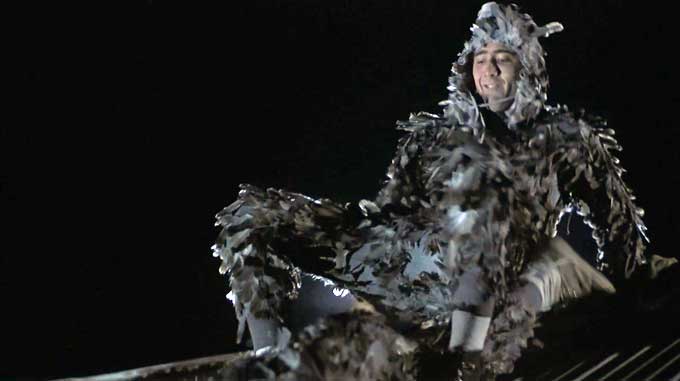
Final thoughts: I enjoyed Birdy and thought it a confident anti-war film. Some of the shadowy interior shots and close ups did make me think of Angel Heart (1987), an Alan Parker film that I have a real affection for. Cage is perfectly cast as a counterpoint to Birdy, who on the surface appears to be the sensitive one in the relationship. It becomes increasingly evident that the vulnerable one is Al and it’s this break in his macho façade which eventually brings Birdy back. With its depiction of the aftermath of war, Birdy would make a great double bill with Racing with the Moon.
The Cotton Club (1984) directed by Francis Ford Coppola – Plays Vincent Dwyer
Set in Harlem during the 1920s, the film follows a variety of characters which centre around the titular club. Dixie Dwyer (Richard Gere) is a cornet player who catches the attention of local gangster Dutch Schultz (James Remar) and after saving his life, he hires Dixie as a musician/general factotum. He also hires his brother Vincent (Cage) as muscle but he becomes increasingly erratic, starting a war between the various gangs operating in Harlem. Amongst the gangland action, musicians and performers weave into the story, including Sandman and Clay Williams (Gregory and Maurice Hines) who perform at the club. Dixie falls for Dutch’s mistress, Vera Cicero (Diane Lane) which starts to cause him problems. He eventually breaks away from Dutch with the help of Owney Madden (Bob Hoskins) who owns The Cotton Club. Dixie becomes a Hollywood star and returns to perform, reuniting with Vera. Dutch is taken out permanently whilst Sandman performs on stage.
Teeth watch: still all there which means this was filmed before those milk teeth were yanked out for Birdy.
Best Cage wardrobe: he looks pretty great in a suit and Brylcreemed hair.
Final thoughts: I found The Cotton Club pretty underwhelming. I have an appreciation for its ambition and very much liked the music and dance numbers which occur frequently throughout. The plot surrounding it, though, was thin and the characters were not developed enough to make any real impression. There are some good performances – Diane Lane, the Hines brothers, Larry Fishburne, Bob Hoskins and Lonette McKee. Richard Gere looks fantastic with his cornet (which he played himself) and Tom Waits is always a great presence. However, James Remar is terribly miscast and sadly Cage is too.
Vincent is not on screen much but to sum him up he’s a racist, not very bright wannabe gangster. His story arc ramps up quite dramatically when his reckless actions result in children being killed but there’s just no space for it to breathe. When Vincent gets the expected ending (shot to death in a phone booth) it barely registers at all. Not least with Dixie who seems unmoved by his brother’s death. To connect this to the previous Cage film (sort of), his portrayal of Vincent brought to mind the 1976 Alan Parker film Bugsy Malone. He looked like a kid playing a gangster and it just didn’t work (unlike the kids in Parker’s film).
The story around the making of The Cotton Club is way more dramatic than the film, not least the murder of Roy Radin who was a financial backer. It’s worth doing a deep-dive on the troubled production: that story could be a film in its own right. To end on a positive, I already mentioned the music and dance numbers, they really do shine and inject some seriously needed energy. The soundtrack by John Barry is great and the perioding through costumes and décor looks sumptuous, Dick Silbert’s art direction is as spot on as you’d expect. I would still say give it a watch if you haven’t had the pleasure.
View from the Ferris wheel:
Cinema Rediscovered Festival in Bristol – I saw a lot of films and talks during my two days at the festival. I particularly enjoyed the Mexican Rumberas trilogy starring Ninón Sevilla and the two Iranian documentaries – Celluloid Underground (2023) and Pouring Oil on Troubled Waters (2023). This was my first time attending and I had a blast – will certainly be back in 2025.
Kinds of Kindness (2024) at The Rex, Berkhamsted. Not as good as Poor Things (2023) but decent nonetheless and it’s always fun when Yorgos Lanthimos goes more “out there”. The first story was my favourite.
Deadpool & Wolverine (2024) at the BFI IMAX. It won’t change your life but it made my friend and I laugh a lot. I thought it was good fun and not as bad as some of the more sniffier reviews suggest.
Sky Peals (2023) at the BFI Southbank. A very solid depiction of mental health and loneliness. Moin Hussain’s debut is impressive in places, I especially liked the motorway service station setting in that you’re somewhere and nowhere at the same time. Some parts didn’t quite work but this was a confident debut and I’ll certainly be looking out for Hussain’s future films.
Archipelago (2010) at the BFI Southbank. Joanna Hogg’s family holiday horror show is a study in simmering resentments and passive aggression. Really well executed and I get more impressed by Hogg each time I see her work.
Only the River Flows (2023) at The Rex. I really liked this, it seems at first to be a standard police procedural but begins to blur around the edges as the main character (an excellent Zhu Yilong) struggles with domestic and professional pressures. It was shot almost all on 16mm film which gives it a dark, grainy quality that invokes the 1990s time period perfectly.
The Lord of the Rings extended editions all-nighter at The Prince Charles Cinema, Leicester Square. My friend and I like to do this every few years and it’s a great way to experience the trilogy.
The Outrun (2024) at the BFI Southbank. Saoirse Ronan and Paapa Essiedu are terrific in this tale of a recovering alcoholic. Some great imagery and a delicate subject handled very well. It’ll make you want to visit the Orkney Islands.
The Wicker Man (2006) at The Prince Charles Cinema. *Sigh*. Yes, my friend and I paid actual money. Fun audience and honestly can’t wait to write about this in more depth.
BFI London Film Festival – much like Cinema Rediscovered, I watched a lot of films. Favourites were The Surfer (2024) and Dahomey (2024). The former is Cage on very fine form in Lorcan Finnigan’s sun-drenched nightmare. The latter is a documentary by Mati Diop (do catch her fantastic directorial debut Atlantics (2019) on Netflix) about reparations of objects from France to the Republic of Benin. Diop is on strong form here, I particularly enjoyed the student debate. This is on widespread release now so do look out for it.
Joker: Folie a Deux (2024) at BFI IMAX. I really enjoyed this despite being in the minority. There was some brave decisions made with the narrative and themes but to me, it worked. I liked it more than the first one.
Timestalker (2024) at Curzon, Bloomsbury. I am a huge fan of Alice Lowe and I raved about Prevenge (2016) when it came out. This one is not as good but enjoyable, pretty funny and offers up some interesting themes to unpack.
My favourite Cake (2024) at The Rex. Lili Farhadpour and Esmaeel Mehrabi are bloody brilliant in this bittersweet film which contemplates human connection. I felt both uplifted and desperately sad at the end.
 The Cuckoo Clock Film Blog