Rumble Fish (1983) dir. Francis Ford Coppola – plays Smokey
Contains spoilers
Rumble Fish is Nicolas Cage’s first credited role in a film directed by his uncle and it came out in October 1983, just four months after Valley Girl. Similar to the earlier film, this is a teen flick but Cage has the secondary role of Smokey, one of the gang and inner circle of Rusty James (Matt Dillon). Rumble Fish is a coming-of-age film (a genre I love) and includes the familiar tropes such as gangs, romance and a cool older sibling. There’s also a sense of unfamiliarity about it. It’s shot entirely in black and white, with the exception of the red and blue Siamese fighting fish in the pet store. It has a drum-heavy, disjointed soundtrack composed by Stuart Copeland and is shot in a surreal, dreamlike way using light and shadows which are more suggestive of the film noir and German expressionist genres than a teen drama.
Rumble Fish was shot two weeks after shooting wrapped on Coppola’s other teen drama, The Outsiders (1983) and included many of the same cast and crew. Rumble Fish was also based on a book written by the same author as The Outsiders, S. E. Hinton. I watched The Outsiders recently and they make a decent double bill. There are parallels between the films such as a central fraternal relationship, the search for identity through gang life and the inevitable death at the end. They are stylistically very different, though, because The Outsiders is shot in colour and has some of its key scenes in sun-dappled, idyllic countryside. The ending conveys hope for several of the characters whereas Rumble Fish with its monochrome palette and frequent shots of urban decay feels heavier and more pessimistic.
And so to Mr Cage. He plays Smokey, a key member in a gang led by Rusty James. We meet the gang at Benny’s Billiards (Benny is played by Tom Waits) when Midget (Lawrence Fishburne) enters and tells Rusty James that Biff Wilcox wants to fight him under a bridge that night. We get a sense of the characters very quickly here: Rusty James is laid-back and ready to go and Chris Penn’s B.J. is instantly game showing his loyalty and taste for violence. Smokey agrees but is reluctant. He seems keen on the fun side of gang life (such as hanging out in pool halls) but less so on the organised dust ups. The bookish Steve (Vincent Spano) is dead against it. He reminds Rusty James that his brother, known as The Motorcycle Kid (Mickey Rourke), would not approve. This is where we learn that The Motorcycle Kid has been gone for two months and no one has heard from him.

The gangs meet and Biff (Glenn Withrow) is magnificently punchable with his sweaty face, shite hair and round shades. The fight which ensues feels like a nod to West Side Story (1961) with its choreography and frenetic soundtrack. The boys dance around one another and swing from random chains. You could almost be watching The Sharks and The Jets if, back in 1962, they were allowed to show Bernado putting Riff’s head through a window. The fight is won by Rusty James but an unexpected appearance by The Motorcycle Kid distracts him and Biff slashes Rusty James’s stomach. The Motorcycle Kid jumps to his brother’s rescue by launching his bike at Biff and motorcycling him into unconsciousness (there’s a noun I never thought I would verb).
The return of The Motorcycle Kid moves the story on to the familial relationship which includes their alcoholic father (Dennis Hopper). Rusty James’s gang begins to recede into the background which means Cage’s Smokey doesn’t make another appearance until towards the end. (For this reason I won’t deep dive into the main body of the film but there are plenty of interesting takes should you wish to look them up.)
In short, Coppola does something genuinely unique with the genre and the hubris and brevity of youth is visible everywhere via references to the passage of time. Shadows elongate, clouds float by and ticking clocks appear in shot. Waits’s Benny laments on how the young can just let time pass as the camera lingers on a close-up of a looming wall clock which, from the high camera angle, seems to ominously hang over the gang’s main hangout spot. It is also a countdown. From the minute the film opens Rusty James has the sense of someone on borrowed time and with the return of his brother, a legend he so desperately wants to emulate, this becomes more apparent.
There is a dream-like quality to the film which comes from the noirish genre conventions but it’s expressed through the dialogue and interactions. Diana Scarwid’s Cassandra is a strange almost ethereal presence. Her mythical Greek namesake is referenced by The Motorcycle Kid making one wonder if she really is as strung out and nonsensical as she seems. The Motorcycle Kid is an enigma, he is a significant character but compared to the fizzing energy of Rusty James, his presence is that of a weary observer. The out of body experience, where Rusty James briefly dies and floats above scenes of his family and friends lamenting his passing, is pretty great and almost trippy. Coppola achieved this effect by having a body mould taken of Dillon so he could lie in it and be hung on his back and literally float over the action. The effect is terrific and the slight scrappiness of this set-up just adds to the surrealness of the film.
I agree with the take of the late, great Roger Ebert in that Coppola’s comparison between the colourful Siamese fighting fish and the brothers works: the claustrophobic environment they inhabit encourages violence but survival is not guaranteed if they are liberated from it. I can appreciate that Rumble Fish is not for everyone but I was won over, I haven’t seen a teen film quite like it.
Returning to Cage’s Smokey, his behind-the-scenes machinations whilst Rusty James is reconnecting with his brother has a personal impact on the main character’s story arc. Patty (Diane Lane) is the long-suffering girlfriend of Rusty James and he appears to carry some affection (or at least a healthy amount of lust) for her but ultimately treats her as a commodity he can call on when it suits him.
Smokey throws a terrifically debauched party at a lake house where the teenagers get naked and have a marvellous time. This includes Rusty James who knocks boots with a brunette who is absolutely not Patty. Word gets back to her and she drops him. This was Smokey’s plan all along and when Rusty James spies Patty entering Benny’s, his attempts to woo her back are humiliatingly scuppered when it’s clear she’s waiting for her date, Smokey, to arrive.
The short scene between the two friends shows how life has moved on whilst Rusty James was occupied with his brother. Smokey agrees to go outside to talk but makes it clear he has no intention of fighting over his new love interest. Their interaction seems different. Smokey occupies an equal space within the frame and his height advantage is evident. Rusty James appears to have physically shrunk since their last contact. Smokey has ditched his teen jacket from the opening scenes and appears grown-up with his open-collar white shirt and easy drawl. His distancing from gang life feels inevitable and has a direct parallel with The Motorcycle Kid who, since his return, has shown zero interest in returning to his old ways.
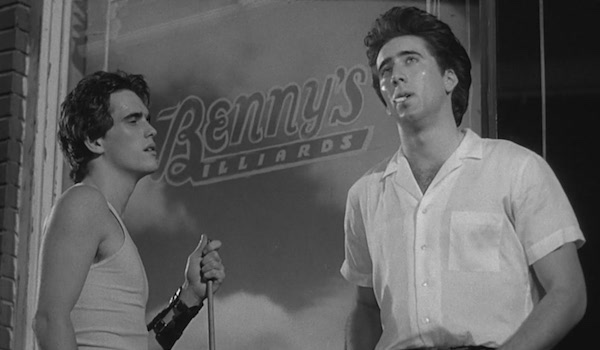
This exchange between them could have served as a wake-up call for Rusty James as Smokey’s change is another signifier of time passing. In a misguided move, Rusty James hands Smokey his pool cue as a symbolic gesture of passing on the baton (or the girl) and forgiveness; Smokey drops it to the pavement and goes back to Patty. Rusty James doesn’t stop to think, he doubles down on wanting his brother’s former life and the countdown continues.
Cage was interviewed briefly about his part in a Behind the Scenes video and noted his inspiration for the character was a lizard he spotted once whilst swimming in a ditch. Apparently the lizard was smiling just before it bit him and Cage realised that this lizard just loved biting people. This is what he thought of when bringing the character to life. For the record Smokey doesn’t actually bite anyone but perhaps Cage was channelling the lizard’s motivation into Smokey’s actions; showing that he’s all instinct and doesn’t mean to hurt anyone. Who the hell can tell but those of you who know me in real life will be aware that I love lizards. The merging of these two obsessions just about blows my mind.
I won’t spoil the ending, it is both bleak and hopeful and if you haven’t watched Rumble Fish it’s worth a look. Come along for the mashing up of genres and surreal retelling of a classic teen story, stay for the bitey lizard inspired Cage performance.
Next time: Rowdy Herrington’s Road House (1989) – a solid gold classic and I will fight you if you disagree.
Best Cage Rage Moment: sadly none, he’s pretty chill throughout
Best Cage Quote: nothing he says in the film tops the lizard anecdote so let’s skip it.
View from the Ferris Wheel
As it’s been so long, I’ve watched a lot of stuff so won’t list everything but here are the highlights:
Jane Campion’s In The Cut (2003) – seen at the BFI Southbank and just bloody brilliant, cannot believe it’s taken me so long to see it.
Carl Franklin’s Devil in a Blue Dress (1995) – available to rent on Amazon Prime, terrific noir film with Denzel Washington. Loved it so much I’m now borrowing all of Walter Mosley’s Easy Rawlins books from my local library.
Sophie Coppola’s Priscilla (2023) – currently on Mubi, enjoyed this. Very slow and languorous but always from Priscilla’s view point.
Tarik Saleh’s Cairo Conspiracy (2022) – seen via my local film society, not earth shattering but an interesting thriller showing tensions between state and religion.
Aki Kaurismäki’s Fallen Leaves (2023) – currently on Mubi, typically deadpan offering from the master of such things. It has the usual misfit cast of characters and is delightfully optimistic.
Sacha Polak’s Silver Haze (2023) – seen at the BFI Southbank, second feature from Polak and really interesting. Great turn from Vicky Knight.
Denis Villeneuve’s Dune: Part Two (2024) – seen projected at the BFI IMAX, insanely good and better than Part One. Recommend seeing it on the big screen for the cinematography but also the sound design and score.
Andrew Haigh’s All of Us Strangers (2023) – currently on Disney+, wonderful cast and damn near broke my heart. It lives up to its hype.
I also went to a David Lynch all-nighter at London’s Prince Charles Cinema and watched the following:
Blue Velvet (1986)
Wild at Heart (1990)
Lost Highway (1997)
Mulholland Drive (2001)
All bloody brilliant films and seeing the latter two whilst sleep deprived was certainly an experience.
Sarah Polley’s Women Talking (2022) – currently on Amazon Prime, this is incredible filmmaking. It is literally women talking in a barn but it is also so much more than that. The cast is impressive and it packs more of a punch than you’d imagine.
Alfred Hitchcock’s Rope (1948) – seen at the BFI Southbank, one of my favourite Hitchcock films, it’s tense and you sort of want them to get away with it. The film had an insightful and amusing intro by one of the BFI film curators.
As Rope has a definite Patricia Highsmith vibe, it’s worth mentioning that I finished the Ripley series on Netflix. It took a few episodes to get into it but I really liked it. I am fan of the Anthony Minghella 1999 film but Andrew Scott’s chilly, more sociopathic portrayal was very like how I imagined Tom Ripley from the book.
 The Cuckoo Clock Film Blog