
Contains spoilers
I love themes of community in film. When a group of disparate people connect through place or experience and then band together for the common good, I’m all in. One example is The Titfield Thunderbolt (1953, dir. Charles Crichton), in which the residents of Titfield village take over their train line when hearing about the government-run National Rail plan to close it. A more recent instance can be found in Takashi Yamazaki’s excellent Godzilla Minus One (2023) when Kenji Noda (Hidetaka Yoshioka), frustrated by government inaction, assembles his own crew of willing and capable Navy volunteers to enact his plan to stop the monster.
When thinking about communities, Finnish writer and director Aki Kaurismäki may not immediately spring to mind. Having worked my way through some of his back catalogue, I was reminded that he often focuses on characters who are isolated through socio-economic circumstances, grinding bureaucracy or are simply outsiders. They dream of better things and their salvation is delivered by meeting and connecting with another kindred spirit. Interactions are deadpan and humiliation and disappointments are endured stoically. No matter the situation, Kaurismäki’s sympathies lie with his characters. Even when events turn a person murderous, such as Iris in the mesmerising The Match Factory Girl (1990), your heart is with her until the end.
That’s not to say communities never feature in his work. In Drifting Clouds (1996) an entire restaurant team is fired after a takeover and the gang rally around the head waitress when she attempts to open her own business. Similarly, in The Man Without a Past (2002) the man of the title is befriended and helped by a family who have made their own small community in containers in Helsinki.
Le Havre (2011) is set in the titular French port town and whilst it characteristically features working class characters, Kaurismäki widens his focus to refugees arriving in Europe. The main players are the wonderfully named Marcel Marx[1] (André Wilms), a shoe shiner who is proud of his job as it brings him, like a shepherd, closer to the people. Idrissa Saleh (a terrific debut from Blondin Miguel) is a young Gabonese refugee who escapes from a shipping container after he and his other fellow travellers are discovered by a night watchman.
Before the container is opened we are introduced to Inspector Monet (a glumly handsome Jean-Pierre Darroussin). When questioning the need for armed police, he is wearily told they are following orders from the Minister of the Interior. As the container is opened, mid close-ups linger on the people inside. They look directly into the camera and during this scene, time hangs still. The audience is given the space to take in each person and really see them. In a moment which sets Monet apart from the other police present, he prevents an officer shooting the young Idrissa when he flees.
Marcel’s first insight into these events comes via a hyperbolic newspaper headline, which questions if the missing boy is “Armed and Dangerous”. Presumably the gun-toting welcome the unarmed refugees encountered was omitted from the article. A real-life event which enters the diegetic world comes via a news report in Marcel’s regular drinking hole and community hub, Le Moderne. Television rarely appears in Kaurismäki’s world and when it does, it is the bearer of bad news (radios are a more comforting presence). The news report shows the bulldozing of the so-called Jungle Camp in Calais and the arrest of the occupants with no mention of where these displaced people are supposed to go.
The scene is interesting as it ties the film to a point in time. Le Havre was released in France in 2011 so presumably this news report relates to the 2007 camp demolition. We are well into an era of televisions, mobile phones and modern amenities yet Le Havre shows barely a sign of them. The characters and spaces seem frozen, with not a great deal to distinguish them from the Kaurismäki films of the 1990s. Indeed, the only character seen with a mobile phone uses it to shop Idrissa to the police and is credited as Denouncer (played by French new-wave royalty Jean-Pierre Léaud). When asked about this scene in a May 2012 Sight and Sound interview, Kaurismäki agrees that the mobile phone is an instrument of the devil. A rejection of the conveniences of modern life is evident throughout Le Havre but the disconnect between events and time is not jarring. The story of Idrissa and Marcel is a parable and the success of this tale and its message is in its simplicity.

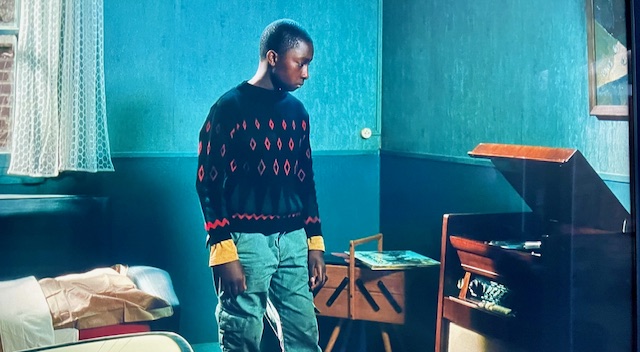
An element of the film which ties in to previous Kaurismäki outings is the colour palette. His films have neutral tones and in some ways this is true of Le Havre. The main colour is blue which feels like a continuation both of the sea and of Idrissa’s journey. Amongst these various shades are pops of red: Marcel’s sofa cushion, a plant pot in a hospital room, a pan boiling an egg and the diamonds on Idrissa’s jumper. They draw the eye and are almost anchor-like within the frame. At times they signify modest moments of comfort and normality. Yellow makes an appearance in this aquatic hued world but we’ll come to that.
Idrissa and Marcel’s meeting is fated. Idrissa, instinctively trusting Marcel, emerges from his watery hiding place and asks where he is. Marcel leaves food and water in the same spot later on and after rushing his beloved wife, Arletty (Kaurismäki regular Kati Outinen) to hospital, finds Idrissa sleeping in his shed being watched over by his dog, Laika. As in all good stories, the dog is a great judge of character. Marcel does not seem surprised to discover his stowaway and he knows what he must do. He will help Idrissa, even if he’s not entirely sure how.
The community has a similar unspoken reaction. The Boulanger, Yvette (Evelyne Didi), frequently exasperated with Marcel for stealing baguettes, starts handing over free bread. She agrees without question to take in Idrissa when needed and the Grocer, who used to all but drop his shutters down on Marcel’s head, hands over free food to help feed the young lodger. Kaurismäki’s sparse, deadpan delivery works so well when illustrating how the strings which already tied these people together strengthen through a young refugee needing support. Sometimes the right thing to do is so obvious, you just bloody do it.
Community ties are not just present within Marcel’s corner of Le Havre. After getting the necessary information from Idrissa he travels to Calais in search of his grandfather, Mahamat Saleh (Umban U’kset). Marcel engages with the refugee community there and, through their network, hears that Mahamat is being held in a nearby detention centre.
Naturally detention centres are not the sort of places where one can just walk into and visit someone. Kaurismäki’s writing may be deadpan but he’s very funny. Marcel arrives and declares himself as Mahamat’s albino brother, notes he is both a lawyer and a journalist, points at a law book on the desk and announces he is recording the conversation. The irritated warden grudgingly agrees him access. It’s a wonderfully comic moment which tips into such a level of absurdity it becomes oddly believable but it also carries a somewhat darker undertone. It shows a system which gatekeeps visitors and the potential difficulty for the detainees to access assistance from the outside.
During their meeting, Mahamat passes on the London address where Idrissa will find his mother. He also reveals Idrissa’s father has died. No further details are given and Marcel does not ask. It’s a touching moment between the two men, not least due to the ambiguity of Mahamat’s fate from this point onwards. This sad insight into Idrissa’s family circumstances breathes more significance into a later scene which also happens to be my favourite.
Marcel returns home to a record playing which is Statesboro Blues by Blind Willie McTell. We see Idrissa standing next to the record player, transfixed. The lyrics, which include the line “My daddy died and left me wild, wild, wild”, fill the space. Idrissa’s expression conveys a life already lived beyond his years. With Statesboro Blues still playing, the scene segues into Marcel and Idrissa, who is now in a yellow top, sitting outside together. They look content in each other’s company. It’s an ordinary moment but gently confirms Marcel as Idrissa’s temporary father figure. The simplicity of this scene, which captures their developing affection and resilience, is utterly sublime.

With Idrissa’s destination confirmed, Marcel gets to work and again the community comes through. Through a local boatman (who only requests the price of fuel as payment), he arranges the crossing to England but needs €3000 to pay the people on the other side of the channel. This money is immediately offered by Marcel’s neighbours but he refuses and raises the money via a “trendy charity concert”. Kaurismäki’s films always contains a live music performance and in Le Havre real-life French singer, Little Bob, is our musician. The money is raised and Marcel has everything in place for Idrissa’s journey.
It’s worth pausing here to consider Idrissa’s escape to the awaiting boat. One might be forgiven for thinking that a small community making a living in a poor corner of a port town would be no match for the police. Yet they spirit Idrissa away right under the uniforms’ noses by simply exploiting the ties we already knew existed. When the Grocer wheels off his vegetable cart and dismissively tells the police to speak with his wife, it does not occur to them that Idrissa is hidden inside. Kaurismäki frequently shows his characters fighting powerful social systems and it’s delightful to see this group cheerfully making a fool of them.
There is much more that could be explored in Le Havre, such as the story of Marcel’s friend, Chang (Quoc Dung Nguyen) who, like the protagonist in Kaurismäki’s The Man Without a Past, has left his old name and identity behind him albeit for different reasons. Not to mention the surreal scene when Monet enters Le Moderne bar carrying a pineapple before a guarded but intimate discussion with the proprietress, Claire (Elina Salo). It’s a rich tapestry of characters and circumstances which makes for a funny, political and thought-provoking film.

And to our ending. Or endings, Le Havre has two of them. As we approach the denouement, yellow appears a little more frequently: we already saw Idrissa’s top after the Statesboro Blues scene, there is Chang’s jacket when he assists with the Little Bob concert and the boatman’s waterproof as Idrissa sets off on his journey. There is something about the colour which feels like a transition or a shifting of the story. It’s pleasant on the eye, bringing an air of optimism and hope.
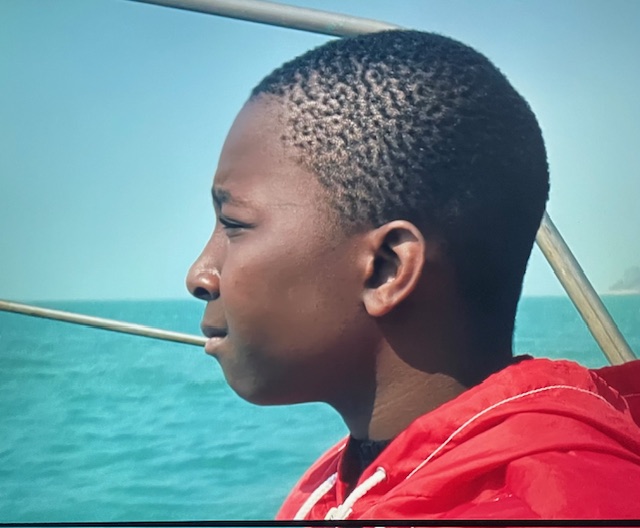
Idrissa’s parting with Marcel is typically Kaurismäki; they say what needs to be said with genuine feeling but it is stripped of sentimentality. Idrissa allows himself one glance back towards Le Havre as the boat leaves the port. He then resolutely looks ahead, there is only the faintest hint that he is holding back tears.
For Marcel, it’s onwards to the hospital to collect his beloved wife. We learnt early on that Arletty’s condition is much worse than she lets on to Marcel, her prognosis is grim and she’s not expected to survive. It becomes clear during her absence that Idrissa was as much Marcel’s salvation as he was Idrissa’s. Arletty had told Marcel to stay away during her treatment, knowing he could not deal with her terminal illness. Idrissa gave Marcel’s life purpose during this time, a situation he would not have coped well with otherwise.
Marcel enters the hospital with yellow roses to finally see Arletty after a two-week absence. Her bed is made and unoccupied. A nurse beckons him to see the doctor, telling him that he can collect Arletty’s belongings later. As he arrives the doctors seem stunned, exclaiming that these circumstances rarely happen. Marcel scans the room and sees Arletty who declares her full recovery a miracle. She is wearing a yellow dress.
Next time: the Nicolas Cageathon continues with Rumble Fish (1983).
View from the Ferris wheel:
A decent follow up to Le Havre is Kaurismäki’s The Other Side of Hope (2017) in which the director turns his attention to Finland and their response to refugees. Available to watch on Mubi.
Les Choristes (2004, dir. Christophe Barratier) watched at my local film society as I was on digital projection duty. First time seeing it and it was bloody delightful.
Getting it Back: The Story of Cymande (2022, dir. Tim MacKenzie-Smith) seen at the BFI Southbank. Hugely enjoyed this: the music is great and it’s a fascinating story of a band who deserved recognition in the UK back when they recorded their first album. My beloved is a huge fan so was well chuffed.
I hit the Dorothy Arzner season again at the BFI Southbank with The Bride Wore Red (1937), Joan Crawford is luminous as Anni – a woman plucked from singing in a bar by a drunk businessman and shown the high life for two weeks. She finds love as she hoped she would, just not where she expected to…
Back on digital projection duties with Kelly Reichardt’s First Cow (2021). Seen this before but loved the second watch – beautifully shot and is a slow meander through the American dream.
[1] Wilms also played Marcel Marx in Kaurismäki’s 1992 film La Vie de Boheme and the director confirmed it was the same character. Marcel also makes reference to having lived “the bohemian life” when talking to Idrissa. My sincere hope is one final Marcel Marx outing which sees him reunited with Idrissa.
 The Cuckoo Clock Film Blog